

The digital landscape has undergone a seismic shift. If 2023 was the year of the “Chatbot” and 2024 was the year of “Integration,” then 2026 has officially emerged as the Year of the AI Agent. We have moved past the novelty of AI that speaks and entered the era of AI that acts.
At Insiteblog, we’ve tracked these developments closely. We are no longer looking at a future where AI is a separate tool we occasionally consult; we are living in a present where the most successful professionals are “Human-AI Hybrids.” This guide explores how this transition is redefining productivity, creativity, and the very nature of work.
1. The Shift from Chat to Agency: From Talking to Doing
In 2023, the world was mesmerized by Large Language Models (LLMs) because they could write a poem or summarize a meeting. They were passive. You gave a prompt; they gave a response. We called this the “Chatbot Era.”
In 2026, the paradigm has shifted to Agency.
What defines an AI Agent?
Unlike a chatbot, an AI Agent possesses a degree of autonomy. It doesn’t just suggest a workflow—it executes it.
- Contextual Memory: Agents now understand long-term project goals, not just the last three messages.
- Tool Use: They can browse the web, access APIs, edit files in your local directory, and communicate with other agents.
- Task Decomposition: If you tell an agent to “Launch a newsletter,” it breaks that down into drafting, image generation, subscriber segmentation, and scheduling.
“To run local AI agents or handle heavy datasets, your hardware needs to keep up. We’ve previously discussed how mid-range powerhouses like the [Motorola Edge 70 Pro] are pushing the boundaries of mobile-integrated AI.”
The “Human-AI Hybrid” professional doesn’t spend their day typing “Please write an email.” They spend their day overseeing a fleet of agents that are busy managing their calendar, triaging their inbox, and drafting their code.
2. Coding & Software: The Rise of the Architect
The most visible transformation of this hybrid era is happening within the IDE (Integrated Development Environment). For years, junior developers were judged by their ability to memorize syntax and debug boilerplate code. In 2026, that barrier has effectively evaporated.
The Power of Cursor and PyCharm
Tools like Cursor and PyCharm (integrated with advanced reasoning models) have turned the editor into a collaborative partner.
- Cursor allows developers to “chat” with their entire codebase, making massive refactoring tasks possible in minutes.
- PyCharm’s AI-driven environment can now predict logic errors before a single line is executed, acting as a permanent senior peer reviewer.
“To run local AI agents or handle heavy datasets, your hardware needs to keep up. We’ve previously discussed how mid-range powerhouses like the [Motorola Edge 70 Pro] are pushing the boundaries of mobile-integrated AI.”
Strategy Over Syntax
In this environment, “Knowing what to build” has become exponentially more valuable than “knowing every syntax.” The role of the “Junior Dev” is evolving into that of a Technical Architect.
“The bottleneck is no longer the fingers on the keyboard; it is the vision in the mind.”
The hybrid professional understands the logic of a neural network or a database schema but lets the AI handle the O(logn) optimizations. This allows a single developer to build and maintain complex full-stack applications that previously required a team of three.
“Mastering these new AI tools requires intense focus, which is impossible if you aren’t recovered. Understanding the [dangers of sleep deprivation] is crucial for any tech professional looking to stay ahead of the curve.”
Vibe Coding
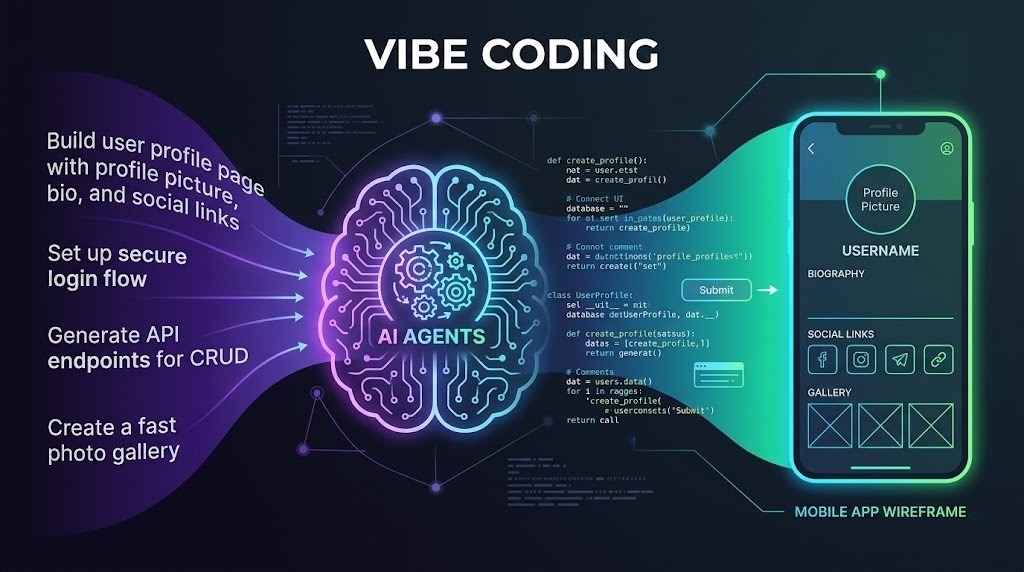
Vibe Coding represents the ultimate shift from “how to build” to “what to build.” In this paradigm, developers use high-level, descriptive language to define the “vibe” of an application—the user flow, the core logic, and the desired experience—while AI agents in tools like Cursor and PyCharm interpret that intent into functional code.
Instead of manually wiring up repetitive CRUD endpoints or agonizing over unit test boilerplate, you provide the “vibe”: “Build a real-time analytics dashboard for a solar grid that feels snappy and uses a minimalist, dark-themed UI.” The AI then generates the schemas, API routes, and testing suites.
The Shift to Orchestration
By 2026, this is no longer a niche hobby; statistics show that roughly 46% of all production code is now drafted by AI assistants. This transition has liberated developers from the “syntax tax,” allowing them to ascend to the roles of Systems Thinkers and Architects.
The modern developer’s value lies in managing complexity, ensuring security, and maintaining the structural integrity of the system, while the AI handles the mechanical execution. In this era, your ability to articulate a clear vision is your most powerful programming language.
3. Content & Digital Media: The Multi-Post Standard
For digital creators and bloggers, the “Hybrid” model is a necessity for survival. At Insiteblog, we’ve seen the standard for “active” publishing shift from three posts a week to 3–4 high-quality posts a day.
The Modern Creator’s Workflow
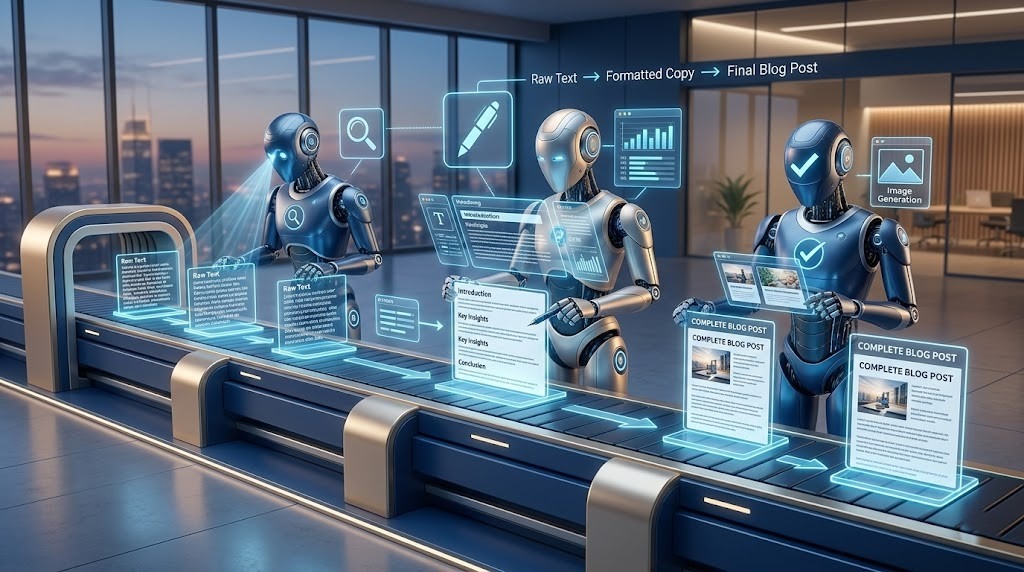
Achieving this volume without sacrificing quality or “soul” requires a sophisticated AI pipeline:
- Ideation: Using AI to analyze trending tech topics and cross-reference them with historical data.
- Drafting & Fact-Checking: AI generates the initial structure and verifies technical specs, while the human adds the “authoritative voice” and unique perspective.
- Asset Generation: AI agents generate custom cinematic, grainy-aesthetic visuals (the signature 90s flash style) that fit the brand’s identity instantly.
- Distribution: AI handles SEO metadata, social media snippets, and newsletter formatting.
This isn’t “automated” content—it’s augmented content. The human remains the editor-in-chief, ensuring the brand’s unique “vibe” and accuracy remain intact while the AI handles the heavy lifting of production.
4. The Essential Skills of 2026
To thrive as a Human-AI Hybrid, the skill set required has shifted away from rote memorization toward high-level cognitive management.
I. Advanced Prompt Engineering (Iterative Logic)
It’s no longer about “the perfect prompt.” It’s about Chain-of-Thought orchestration. Hybrids know how to lead an AI through complex reasoning steps, correcting its “hallucinations” and refining its logic gates.
II. Data Literacy
With AI generating vast amounts of output, the ability to interpret data and spot anomalies is crucial. You must be able to look at an AI-generated report and ask: “Does this trend make sense in the current market context?”
III. Strategic Thinking
When the cost of execution drops to near zero, the only thing that matters is Strategy. What should we build next? Why does this matter to our audience? How do we differentiate in a sea of AI-generated noise? These are human questions that AI cannot yet answer.
5. A Reality Check: Job Loss vs. Force Multiplication
The fear that “AI will take my job” is a valid concern that deserves an honest answer. In 2026, the reality is more nuanced: AI isn’t taking your job, but a professional using AI might.
The Force Multiplier Effect
In the traditional 2020 business model, a marketing campaign or a software feature might require:
- A Project Manager
- A Copywriter
- A Designer
- A Developer
- A QA Tester
In 2026, a single Hybrid Professional can occupy the center of that circle. By leveraging agents for design, code generation, and copy drafting, one person can now do the work of a five-person team.
The Shift in Value
This doesn’t mean there is less work; it means the nature of the work has scaled. Companies are now doing 5x more projects with the same headcount. The “entry-level” has moved up. To stay relevant, you must move from being a “doer” to being an “orchestrator.”
“Just as AI is changing the workforce, it is also changing how we explore the world. We saw this shift recently when comparing the [future of tourism in Andaman], where digital accessibility is now a top priority for travelers.”
6. The Road Ahead: Optimism in the Hybrid Era
As we look at the remainder of 2026 and beyond, the outlook is remarkably bright for those willing to adapt. The barriers to entry for complex fields—whether it’s launching a tech startup, producing a documentary, or managing a global solar energy firm—have never been lower.
We are entering a “Renaissance of the Individual.” The Human-AI Hybrid is a professional who is no longer limited by their technical “blind spots” or the hours in a day. They are limited only by the scale of their ambition.
“The beauty of becoming an AI-hybrid professional is geographic freedom. If you can work from your laptop, suddenly [moving to Plan B countries like Paraguay or Ecuador] becomes a financial masterstroke rather than just a dream.”
The Era of the AI Agent is here. It’s time to stop chatting with the future and start building it.
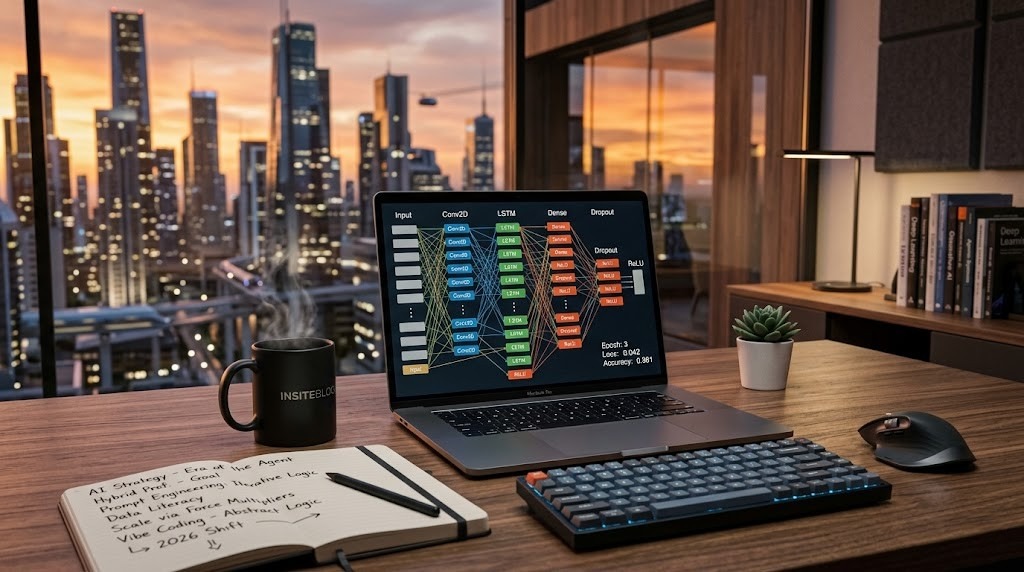
I’ve spent the last few months diving into PyTorch and Python, and if there’s one thing I’ve learned, it’s this: The AI isn’t the threat. The person who knows how to use the AI better than you is. Whether I’m trekking 25km in Jammu or fixing a bug in a neural network, it’s the persistence that matters. Don’t be afraid of the tech; be afraid of standing still.




[…] like mastering the [AI-Human Hybrid skills] we discussed yesterday, securing a spot in the 5,000-visa quota requires staying ahead of tech […]
[…] understanding of modern programming; if you’re just starting out, check out our guide on how [AI-Human Hybrid careers are reshaping software development in […]