
It’s Saturday morning in a sun-drenched cafe—maybe you’re overlooking the greenery of Indiranagar in Bangalore or catching the morning breeze in Indore’s Vijay Nagar. Across from you, someone isn’t just “coding”; they’re hovering over a screen, whispering to an LLM, and sipping a flat white while a fully functional, high-fidelity app blossoms into existence in real-time. There are no frantic Stack Overflow searches, no soul-crushing syntax errors, and zero “standard” boilerplate.
This is the Saturday Hustle in May 2026, and it’s powered by Vibe Coding.
What started as a niche developer meme has officially hit escape velocity. Vibe Coding isn’t just a trend anymore; it’s the new fundamental architecture of creation. We’ve moved past the era of “learning to code” and entered the era of “learning to steer.” It’s the ultimate democratization of creativity—a world where the distance between a “what if” and a live URL has shrunk to zero.
It feels like witnessing a superpower become common knowledge. You don’t need to master the arcane syntax of a dozen frameworks; you just need to hold the vibe—the vision, the flow, and the logic—and let the AI handle the heavy lifting. We are watching the technical barriers to entry evaporate, leaving behind nothing but raw human intent. Whether you’re a poet building a custom distribution engine or a founder spinning up a micro-SaaS before the foam on your latte settles, the message is clear: If you can describe the feeling, you can build the future.
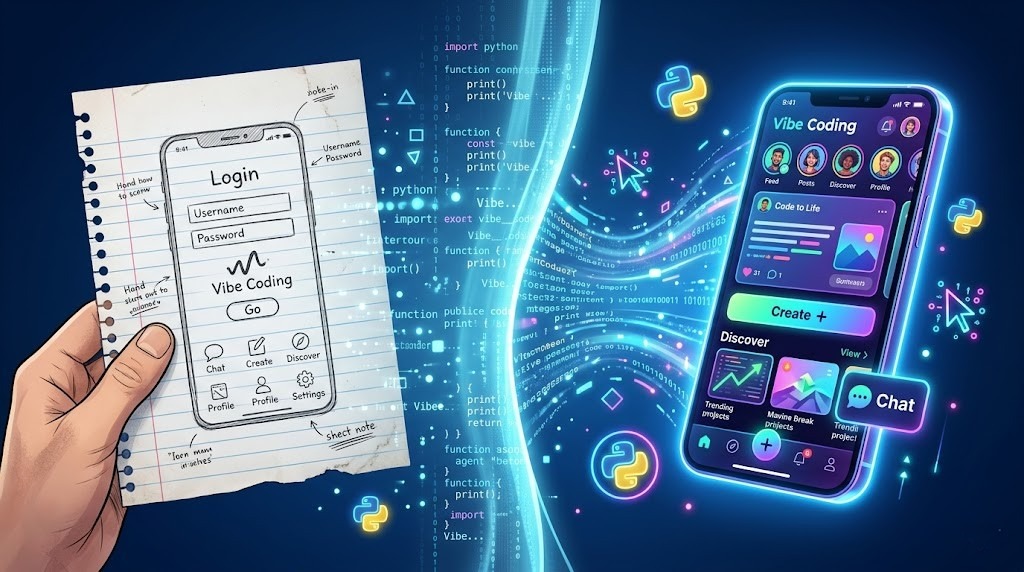
The vibes are officially productive. Welcome to the age of the Human Architect.
The Rise of the Machine Architects
If you haven’t updated your IDE since early 2024, walking into a modern development environment in May 2026 feels like stepping onto the bridge of a starship. The May updates for Cursor and GitHub Copilot have officially signaled the end of the “Autocomplete Era” and the dawn of Agentic AI.
From Autocomplete to Autonomy
The game changed because we stopped talking to our editors like a dictionary and started treating them like a Lead Engineer. Agentic AI is the shift from a tool that predicts the next ten characters to one that understands the intent of your entire system.
- Cursor’s Composer 2: With its new “Autonomy Slider,” you can now delegate a framework migration across 50+ files. It doesn’t just suggest code; it indexes your entire repo, plans the architectural changes, executes the terminal commands to install dependencies, and runs the test suite until the red lights turn green.
- Copilot’s Agent Mode: Deeply integrated into the GitHub ecosystem, Copilot now monitors your CI/CD pipelines. If a build fails at 3:00 AM, the agent can autonomously spin up a branch, trace the stack overflow back to a logic error in your controller, and open a Pull Request with a fix before you’ve even had your morning coffee.
The “Invisible Builder” Shift
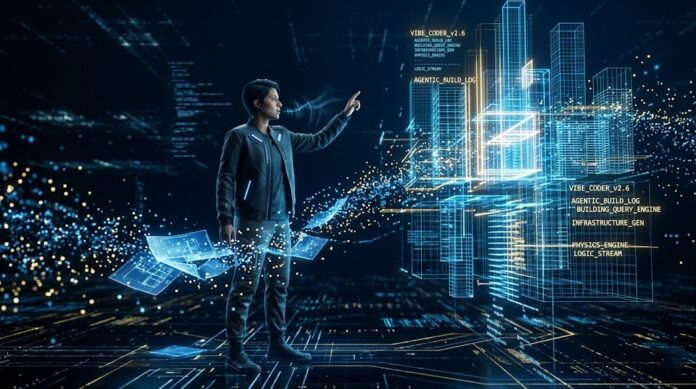
The psychological transition is profound. To use a human analogy: It’s like moving from being a bricklayer to being the architect with a team of 100 invisible builders. Previously, you spent 80% of your day laying individual bricks—worrying about semicolons, import paths, and boilerplate. Today, you stand at the blueprint table. You describe the “vibe” and the structure, and the agents lay the bricks at a million miles per hour. You aren’t typing anymore; you’re orchestrating.
“The transition from a traditional IDE like PyCharm to these agentic tools felt like moving from a bicycle to a jet engine. On a bike, you’re intimately aware of every pedal stroke; in a jet, you’re focused on the horizon while the machine handles the physics of flight.”
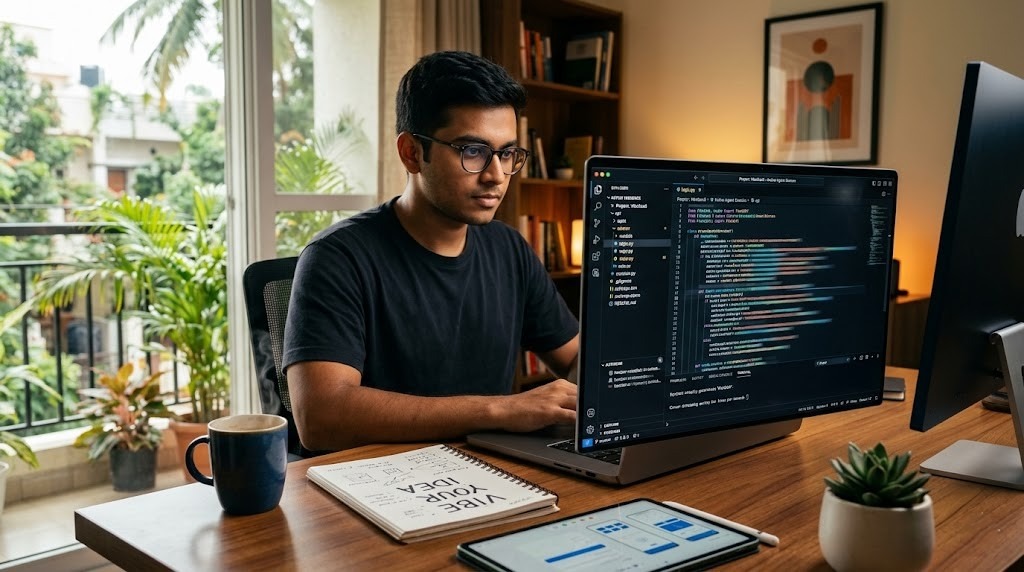
We are no longer limited by how fast we can type, but by how clearly we can think. In May 2026, the “developer” has been replaced by the “architect,” and the codebase has become a living, breathing reflection of pure human intent.
The Ghost in the Machine: Why Python Still Matters
Here is the truth that the “no-code” evangelists won’t tell you: the more powerful the AI becomes, the more your foundational knowledge matters. In May 2026, we might be building at the speed of thought, but thoughts without structure are just hallucinations.
Think of it this way: the AI is now a world-class construction crew. It can raise the walls, paint the facade, and furnish the rooms of an application in seconds. But you? You are still the inspector. If you don’t understand the “pipes”—the data flow, the logic gates, and the memory management—you won’t know why the sink is leaking or why the “house” collapses under the weight of a thousand users.
Python is the language of the pipes.
Understanding Python isn’t about memorizing syntax anymore; it’s about understanding the grammar of logic. Your current path—diving into the fundamentals of Physics, Chemistry, and Math (PCM)—is actually your secret weapon. Logic is universal. When you understand how a variable stores state or how a loop iterates through a dataset, you aren’t just “learning to code.” You are learning to think in a way the machine respects.
This makes you a Master Prompter.
A “Vibe Coder” with no technical depth is just a passenger. But a coder who understands the underlying logic can look at an AI-generated script and say, “Wait, that Big O complexity is going to kill our latency,” or “The way this class inherits is creating a bottleneck.” You become the person who doesn’t just ask the AI to “make it work,” but tells it precisely how to make it elegant.
Don’t let the magic fool you. The jet engine is incredible, but you still need to know how aerodynamics work to keep it in the sky. Master the logic, and you’ll be the one directing the symphony while everyone else is just making noise.
To sustain this level of “jet engine” productivity, your gear has to keep pace with your imagination. While the cloud handles the massive clusters, the local “vibe” depends on hardware that doesn’t stutter under the weight of real-time neural processing.
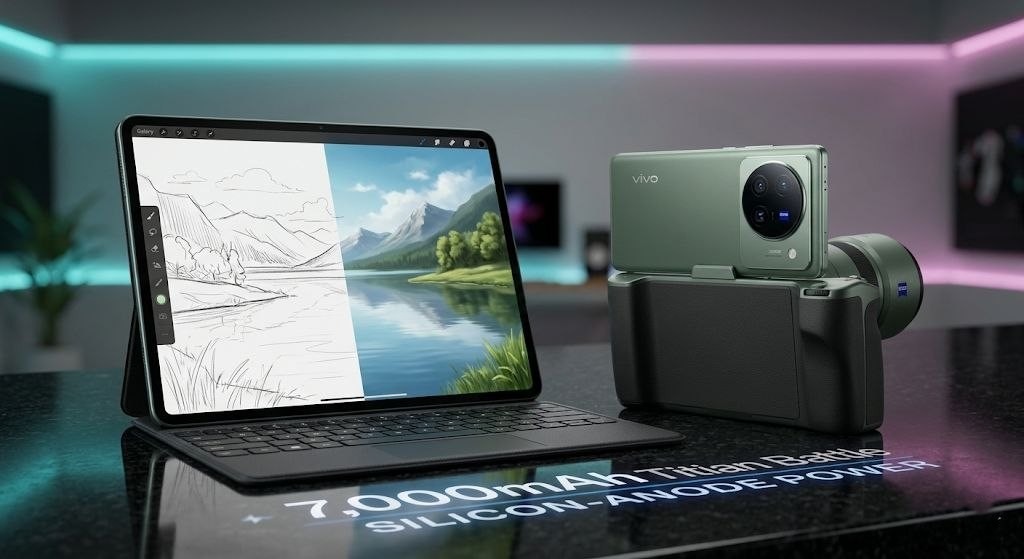
Enter the OnePlus Pad 4. In May 2026, it’s become the gold standard for the mobile architect. With its specialized NPU and the seamless “Open Canvas” multitasking, it’s the perfect companion for a Saturday morning session in Indore. It allows you to keep your agentic terminal open on one side while you sketch UI flows on the other—true mobile “vibing” without the thermal throttling of a traditional laptop.
But there is a final, vital piece of the puzzle. Even as AI takes over the mental heavy lifting, your physical vessel remains the single point of failure. You can’t orchestrate a digital revolution from a place of physical decline. As we discussed in our deep-dive on [Grip Strength & Longevity], your physical stats—your grip, your posture, your metabolic health—are the true foundations of a decade-long career.
The AI might be doing the “coding,” but your body is the one living the life. Don’t let your hardware outpace your health.
The curtain has finally risen on a new era. 2026 is officially the year we stop fighting the machine and start dancing with it. We’ve moved past the fear of replacement and stepped into the power of partnership. The friction that once existed between a brilliant idea and a finished product has worn thin, replaced by a fluid, agentic collaboration that turns “someday” into “seconds.”
But as we embrace this digital superpower, let’s not lose sight of the carbon-based reality that makes it all worth it. Standing on that peak in Nainital last month, looking at those clouds rolling over the Kumaon range, I realized that some things—like a grueling mountain trek—require a physical effort and a presence that AI simply cannot replace. There is no “vibe coding” your way to the top of a mountain; you have to breathe the air and feel the climb.
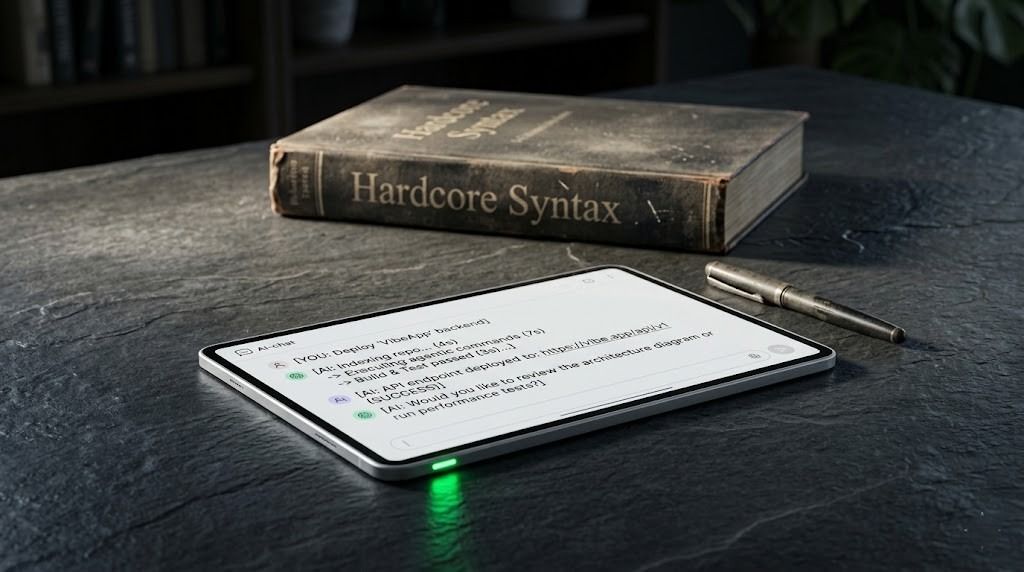
“The barrier to entry has officially hit zero. If you’re curious about how a multi-file ‘vibe-coded’ project actually looks under the hood, I’ve made my recent project open-source: https://github.com/savyasanchi-ai/study-dashboard. Feel free to fork it and add your own vibe.”
However, your ideas? Your creative soul? They no longer have to be stuck behind a wall of difficult syntax or the gatekeeping of technical complexity. The barrier is gone. If you have the vision, May 2026 is the time to build it. We have the editors, the agents, and the hardware to bring any dream to life.
Don’t just follow the vibe—create it.