

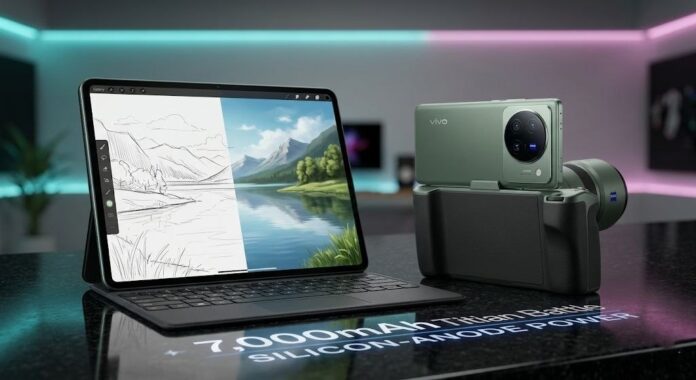
Welcome to the Wednesday Wave. Today is May 6, 2026, and if you are a tech enthusiast in India, your feed is absolutely electric.
This morning, the highly anticipated OnePlus Pad 4 officially went on sale, bringing a massive 13,380mAh cell and PC-level silicon to the tablet arena. Almost simultaneously, Vivo turned heads by unleashing the X300 Ultra’s Photographer Kit, complete with those radical, modular teleconverter lenses and an extra-battery imaging grip.
But if you look past the spec sheets and the flashy launch-day hype, there is a much bigger shift happening right under our noses. We are witnessing the dawn of the “weekend warrior” phone and a new standard of tablet productivity that outlasts your shift.
For years, Indian travelers, remote professionals, and creators have shared a collective trauma: Charging Anxiety. We’ve spent a decade tethered to heavy, brick-like power banks, scanning airport terminals like hawks for an open wall socket, and dreading the “battery low” warning on a crowded local train.
Not anymore. Thanks to high-density silicon-carbon anodes, near-7,000mAh batteries are no longer reserved for bulky, compromise-heavy budget rugged phones. They are rapidly becoming the flagship and upper-midrange standard. When your phone can easily coast through three days of heavy usage, and your tablet refuses to die even after a grueling 12-hour workday, the power bank ceases to be a necessity—it becomes a relic.
Grab your coffee. We’re diving deep into the ultimate battery showdown to see which of these giants truly deserves a spot in your daily carry.
The OnePlus Pad 4: A Creative Powerhouse Built to Outlast
The OnePlus Pad 4 isn’t just another iteration in a stagnant tablet market; it is a declaration of independence from your charger. Priced at ₹59,999—with a killer launch-day bank offer shaving ₹5,000 off the top (bringing it to an effective ₹54,999) and bundling the OnePlus Stylo Pro (worth ₹5,499) completely free—it is positioned to disrupt the premium space.
On paper, the headliner is the jaw-dropping Snapdragon 8 Elite Gen 5 processor. It delivers raw, PC-level muscle that effortlessly handles video rendering or heavy multitasking without a hint of thermal stutter. Yet, for the average student or creator, the real magic isn’t just in how fast the processor runs—it is in what OxygenOS 16 allows you to do with it.
The “Hidden” Software Gems
The true differentiator for this generation lies in its sophisticated, localized AI integration:
- AI Painter: This feature goes far beyond a gimmick filter. For design students or architects sketching on the massive 13.2-inch 3.4K display, AI Painter acts as an instant collaborator. You can scribble a chaotic, poorly proportioned rough sketch of a room layout or a flowchart, and the local AI instantly interprets your strokes, transforming them into clean, professional, presentation-ready vector artwork or structured diagrams in real time.
- AI Summary: Built specifically for the modern multitasker, this tool simplifies information overload. Whether you are dealing with a dense 50-page academic PDF or an extensive corporate transcript, AI Summary condenses the entire document into actionable bullet points, key takeaways, and structured outlines in seconds.
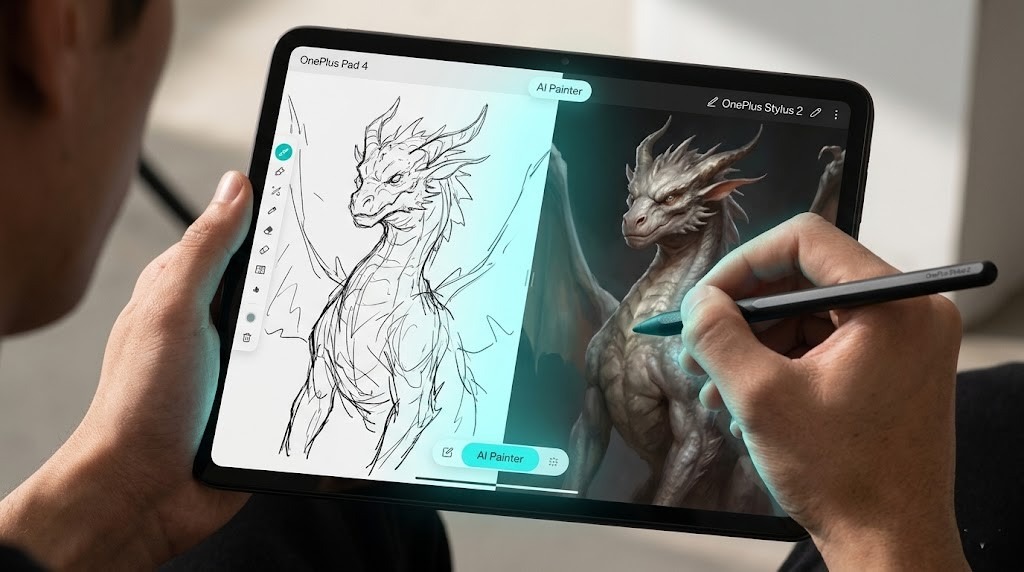
Screen and Battery: Built for the Grind
The canvas for this software wizardry is a stunning 13.2-inch, 144Hz 3.4K panel with a productivity-friendly 7:5 aspect ratio. It looks and feels less like a media tablet and more like a high-end ultra-portable laptop.
Powering this setup is an absolute leviathan of a battery: a 13,380mAh cell. This is nearly double the capacity of even the largest modern smartphones. For a student attending a full day of lectures followed by a late-night study session, or a digital illustrator working on-site, it translates to true all-day freedom. When you finally do manage to drain it, the 80W SUPERVOOC fast charging gets you back in the game in no time.
With the launch deals live today across Amazon, Flipkart, and OnePlus stores, the Pad 4 makes a compelling case for leaving the laptop—and the power bank—at home.
The Vivo X300 Ultra: A DSLR-Killer in Your Pocket
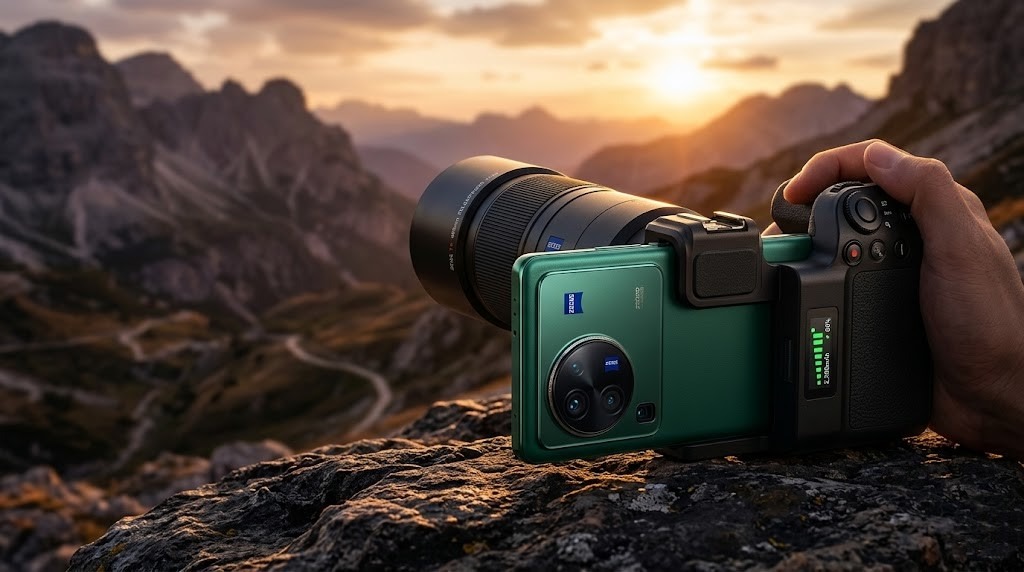
While OnePlus aims to replace your laptop, Vivo is targeting your camera bag. The newly launched Vivo X300 Ultra is not just another smartphone with a decent camera; it is a highly specialized, modular imaging rig designed to make heavy mirrorless setups and DSLRs obsolete for travel and street photographers.
At the heart of this beast is a groundbreaking 200MP main sensor (featuring the custom 1-inch-type Sony LYT901). By moving away from ultra-wide baselines to a more natural, human-centric 35mm focal length, this sensor captures incredible depth, rich tonal ranges, and stunning light sensitivity.
The Modular Magic: Extenders and Power Grips
What truly elevates the X300 Ultra into a league of its own is its ecosystem of physical, clip-on accessories:
- The 400mm Zeiss Telephoto Extender Gen 2: Screw this optical converter onto the periscope housing, and the phone morphs into a long-range powerhouse. Paired with Vivo’s software, it delivers an astonishing 17x optical zoom equivalent. Capturing the razor-sharp ridges of the distant Himalayas or isolating a subject in a chaotic Mumbai bazaar becomes effortless—without carrying a massive telephoto prime lens.
- The Vivo Imaging Grip: This tactical accessory snaps onto the frame to give you physical shutter buttons, tactile dials, and a deeply ergonomic hold. Crucially, it houses a built-in 2,300mAh battery. When combined with the device’s already massive 7,000mAh internal cell, you get a combined capacity of 9,300mAh. You can shoot high-bitrate media from sunrise to sunset without ever seeing a low-battery warning.
Professional-Grade Cinema Tools
Vivo hasn’t skimped on the technical standards that serious videographers demand. The telephoto system is backed by mind-boggling CIPA 7.0 image stabilization (with the main shooter hitting CIPA 4.5), allowing you to shoot handheld at impossibly slow shutter speeds or track moving vehicles without a physical gimbal.
For filmmakers, the phone supports 10-bit Log recording at 4K/120fps with consistent Zeiss color science mapped across all lenses. This gives colorists maximum dynamic range to play with in post-production.
For the modern weekend warrior, the X300 Ultra means you can finally hike, travel, or document the streets with nothing but a sleek, modular device in your pocket—and still bring home gallery-grade results.
Behind the Spec Sheet: The 4th-Gen Silicon Anode Secret
If you look at most tech reviews, they’ll chalk up the massive battery capacities of the OnePlus Pad 4 and the Vivo X300 Ultra to “excellent optimization.” But that misses the actual chemistry breakthrough. The real hero here is 4th-Gen Silicon-Carbon (Si-C) Anode technology, which has quietly reached commercial maturity in 2026.
For decades, lithium-ion batteries relied on pure graphite anodes. While stable, graphite has a theoretical energy capacity ceiling of just 372mAh. Silicon, on the other hand, can theoretically store up to 4,200mAh—over ten times more. The catch? Early generations of silicon anodes would swell up to 300% during charging, causing the battery to physically self-destruct after a few dozen cycles.
Conventional Graphite Anode (Max: ~372 mAh/g)  --> Standard density (Thicker device)
4th-Gen Silicon-Carbon Anode (Up to ~1,500+ mAh/g) --> High density (Ultra-slim device)
In 2026, 4th-Gen Si-C chemistry solves this by embedding highly engineered silicon nanoparticles within a flexible, self-healing carbon matrix. This acts like a structural sponge, allowing the silicon to expand and contract at the microscopic level without expanding the battery’s outer footprint.
Think of it as squeezing a gallon of water into a liter bottle.
By drastically boosting volumetric energy density (surpassing 850Wh/L, manufacturers can now pack unprecedented capacity into impossibly tight spaces. This is how Vivo crams a monstrous 7,000mAh cell into an incredibly sleek 8.2mm chassis, and how OnePlus fits a gargantuan 13,380mAh battery into a tablet that is a mere 5.9mm thin.
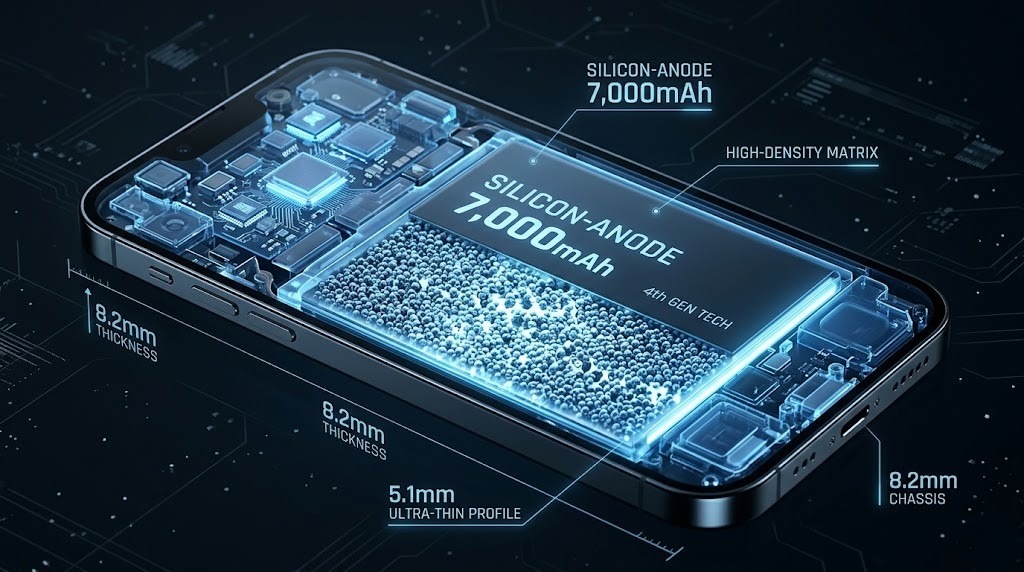
The era of choosing between a slim aesthetic and multi-day battery life is officially over.
Bridging the Tech to Your Everyday Grind
At this point, you might be wondering: “This is incredible engineering, but how does it actually change my Tuesday afternoon?” Managing the Business Boom
Take a look at the macro picture. With India’s gross GST collections skyrocketing to a record-breaking ₹2.43 Lakh Crore in April 2026, the scale of domestic business operations is moving at an unprecedented pace. For independent business owners, CA firms, and retail merchants, staying on top of digital compliance, e-invoicing, and ledger records is no longer a back-office chore—it’s an active, real-time necessity.
This is where a device like the OnePlus Pad 4 steps in. You aren’t just buying a media slate; you are deploying a mobile command center. With the massive 13.2-inch screen running split-screen accounting software and the Snapdragon 8 Elite Gen 5 crunching complex spreadsheets, business owners can file returns, reconcile mismatched input tax credits, and instantly summarize lengthy policy updates using AI Summary—all on a single charge while traveling between client meets.
Chasing the Horizon: From Chopta to Nainital
On the creative side, think about our recent treks through Uttarakhand. If you’ve ever climbed the steep trails of Chopta to watch the sunrise hit the Tungnath peaks, or stood by the quiet lakes of Nainital aiming to capture the distant snow-capped Himalayas, you know the frustration of carrying weight. Every gram of a bulky DSLR body and a massive telephoto lens drains your physical energy.
[DSLR Setup: ~2.5 kg]  VS.  [Vivo X300 Ultra + Grip: ~400 grams]
Result: Same gallery-grade 17x landscape shots; zero back pain.
With the Vivo X300 Ultra, you can leave the heavy backpack behind. Sliding the 400mm Zeiss Extender onto your phone gives you the reach to isolate distant mountain ridges with pristine clarity, while the ergonomic Imaging Grip keeps your hands steady against the freezing mountain winds.
The New Benchmark of Endurance
To put this battery revolution into perspective, consider our current daily driver baseline: the upcoming OnePlus Nord CE 6 Lite. Packing a hefty 7,000mAh battery, the Nord CE 6 Lite is already setting a incredibly high standard for what a budget-friendly, daily-use phone can do, easily stretching to two full days of typical scrolling and calling.
Yet, what Vivo and OnePlus have accomplished with their new flagships takes this benchmark to the next level. By utilizing that 4th-Gen Silicon Anode chemistry, they’ve managed to match—and in the tablet’s case, nearly double—this immense endurance without adding the typical weight or thickness of a mid-range battery champion.
Whether you are managing a rapidly expanding business in the wake of India’s economic surge, or capturing pristine mountain vistas on a weekend getaway, these devices prove that “living on low battery” is finally a thing of the past.
Conclusion: The Era of Uncompromised Power
For the better part of a decade, the tech industry was obsessed with a singular, often frustrating design philosophy: thinness at all costs. We were handed razor-thin devices that looked stunning on a display table but forced us into an exhausting dance of carrying dongles, hunting for wall outlets, and packing heavy power banks just to make it through a standard workday.
But 2026 marks the official end of that compromise.
The launch of the OnePlus Pad 4 and the Vivo X300 Ultra signals a massive, industry-wide pivot toward power and utility at all costs. Thanks to the breakthrough of 4th-Gen Silicon Anode chemistry, manufacturers no longer have to sacrifice sleek, premium aesthetics to give us legendary endurance. We are finally getting the best of both worlds: ultra-slim profiles packed with the kind of battery capacity that once seemed impossible.
On a personal note, this shift isn’t just about specs or chemistry; it’s about the moments we get to keep.
Last year, when I was standing on a peak in Nainital, looking down at that endless, fluffy layer of white clouds, my phone died before I could capture the sun breaking through. It was a moment lost to a dead battery. In 2026, with the OnePlus Pad 4 and the Vivo X300 Ultra, those moments are safe. Whether you are coding on a bus to Sissu or shooting portraits in a misty valley, the tech is finally as resilient as the spirit of the people using it.