

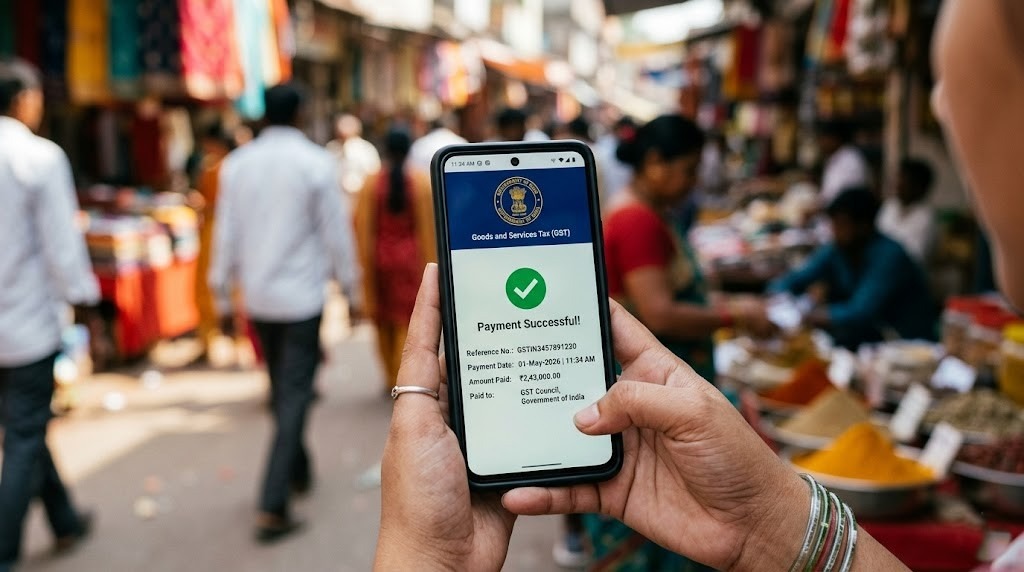
The fiscal landscape of 2026 has opened with a definitive roar. As the global economy grapples with the “Triple Threat”—stubborn inflation in the West, energy volatility in the Middle East, and a cooling Chinese manufacturing sector—India has emerged not just as a resilient observer, but as a dominant engine of growth. The Goods and Services Tax (GST) collections for April 2026 serve as the most potent evidence yet of this divergence.
The ₹2.43 Lakh Crore Milestone
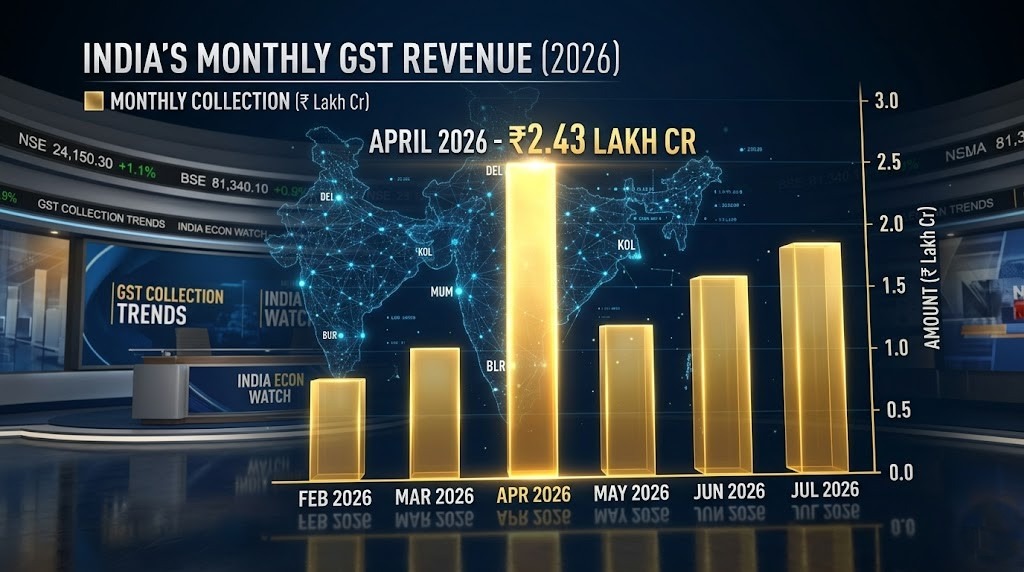
In a historic leap for India’s fiscal architecture, the gross GST collections for April 2026 reached a record-breaking ₹2,42,702 crore (₹2.43 Lakh Crore). To understand the gravity of this figure, one must look at it through the lens of year-on-year (YoY) progression.
In April 2025, the collection stood at ₹2.23 Lakh Crore. This represents an 8.7% growth in nominal terms. However, when adjusted for the moderated inflation rates of 2026, the “real” growth in consumption and industrial activity is even more impressive. This isn’t merely a result of higher prices; it is a result of higher volume.
The net GST collection, after accounting for refunds, stands at ₹2.11 Lakh Crore. This consistent “net-to-gross” ratio indicates a maturing tax system where the friction of refunds is being smoothed out by AI-driven automation, ensuring that the government’s coffers and the corporate sector’s working capital are both better managed.
Domestic Stability vs. the Import Surge: The 25.8% Story
Perhaps the most critical data point in the April report is the source of the revenue. While domestic transactions saw a healthy growth of 4.3%, the revenue from imported goods skyrocketed by 25.8%, contributing ₹57,580 crore to the total.
“This surge in manufacturing-related imports is a clear sign that India’s tech ecosystem is expanding. We are seeing a massive shift in consumer behavior toward high-value electronics, much like the incredible demand we’ve seen for the [Realme P1 5G series since its recent launch].”
What This Tells Us About India’s Manufacturing Demand
Conventional economic theory often suggests that a spike in imports is a sign of a widening trade deficit. However, the 2026 context flips this script. Analysis of the import basket reveals that this growth is driven by Capital Goods and Intermediate Components, specifically in the following sectors:
- Semiconductor Fabrication: With three major plants now operational in Gujarat and Assam, the import of high-end manufacturing equipment and raw silicon has spiked.
- Renewable Energy: The push for the 2030 Green Energy targets has led to a massive intake of advanced photovoltaic materials and wind turbine components.
- Electronics Ecosystem: As India cements its position as the world’s second-largest mobile phone manufacturer, the import of high-value sub-assemblies (which are then exported as finished products) is driving GST at the point of entry.
This 25.8% jump is a leading indicator of future industrial output. Businesses do not import capital machinery unless they anticipate sustained demand over the next 3–5 years.
The ‘Labour Day’ Connection: Productivity as the New Currency
As the nation reflects on Labour Day (May 1st), the GST numbers offer a unique perspective on the Indian workforce. The record collection is a direct result of the “Efficiency Revolution” within the Indian labor market.
From Unorganized to Formalized
The transition of labor from the unorganized sector to the formal economy has hit a “tipping point” in 2026. Formalization ensures that the value added by every worker is captured within the GST net.
- The Productivity Leap: With the integration of AI tools in mid-tier manufacturing and the logistics sector (enabled by the PM Gati Shakti platform), the output per worker has seen a measurable rise.
- The Consumption Loop: A more productive workforce is a better-paid workforce. The April numbers reflect the “festive spillover” and increased discretionary spending by a middle class that now feels more secure in its formal employment.
“This boost in discretionary income is fueling a boom in spiritual and adventure tourism. More Indians are now funding trips to sacred hubs, such as the thousands traveling to [Chopta to witness snow] each week.”

The Regulatory Backbone: 2026 Innovations
The record-breaking collections of April 2026 did not happen in a vacuum. They are the result of aggressive, tech-forward regulatory reforms that went live on April 1, 2026.
1. The New Income Tax Act, 2025
After decades of “patchwork” amendments, the New Income Tax Act of 2025 came into full effect this fiscal year. By eliminating complex exemptions and lowering corporate tax hurdles for manufacturing, it has encouraged businesses to move away from “tax-avoidance” mindsets. The “Unified Compliance Portal” now links GST and Income Tax filings in real-time. This means that a rupee declared in GST is automatically reconciled with Income Tax data, making it nearly impossible for revenue to leak out of the system.
2. RBI’s Two-Factor Authentication (2FA) Evolution
Last month, the RBI transitioned to a biometric and device-bound 2FA system for all high-value digital transactions.
- Reduced Friction: Unlike the old SMS-OTP system, which was prone to network delays and fraud, the new system is instantaneous.
- Velocity of Money: Faster, more secure payments have increased the “velocity of money.” In the GST era, where tax is collected at the point of every transaction, the speed of the digital payment pipe directly impacts the speed of tax collection.
“However, as digital transactions increase, so does the ‘screen time’ for professionals. It is vital to balance this high-speed digital hustle with physical rest; neglecting this can lead to severe cognitive decline, as seen in the [dangers of 48-hour sleep deprivation].”
Market Prediction: The Monday Morning “Reflex”
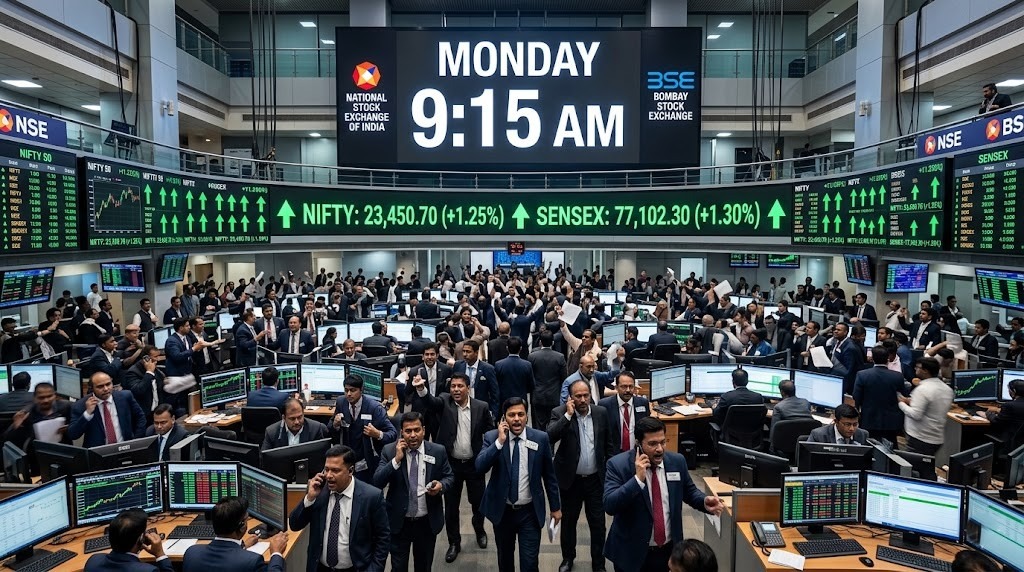
With the Indian markets closed today for the holiday, the “GST shock” (of the positive variety) is being digested by analysts globally. When the opening bell rings on Monday morning, we expect a strong sectoral rotation.
1. The “Consumption” Rally
FMCG (Fast-Moving Consumer Goods) and Consumer Durable stocks are expected to lead the charge. The April data proves that despite global inflation, the Indian consumer is not backing down.
- Key Picks: Companies in the premium electronics and “bridge-to-luxury” segments will likely see a 3–5% gap-up opening.
2. The “Bank Nifty” Surge
Banks are the primary beneficiaries of a high GST environment.
- Credit Growth: Higher GST collections imply higher business turnover, which necessitates more working capital loans.
- Asset Quality: The seamless integration of the New Income Tax Act and 2FA rules reduces the risk of “ghost companies” and fraudulent credit, leading to a rerating of Public and Private sector bank valuations.
The “Big Picture”: Defying the Global Headwinds
Why is India thriving while the Eurozone flirts with recession and the US navigates a “soft landing” that feels increasingly hard? The answer lies in Structural Decoupling.
India has successfully decoupled its domestic consumption from global volatility. While we still import oil and certain technologies, our internal market is now large enough to sustain industrial momentum even when external exports face a slump.
Analyst Note: The ₹2.43 Lakh Crore mark is not a fluke; it is the new baseline. As the 2026 regulations continue to mature, we should expect the ₹2.5 Lakh Crore monthly psychological barrier to be tested before the end of the second quarter.
Conclusion: An Optimistic Horizon
The April 2026 GST report is a manifesto of an economy that has moved past “potential” into “performance.” By combining aggressive infrastructure spending, cutting-edge digital payment security, and a simplified tax code, India has built a fortress. For investors, the message is clear: the “Indian Premium” is justified. The defiance of global headwinds isn’t just luck—it’s by design.
“As we navigate these record-breaking economic times, remember that the best investment you can make is in your own experiences—whether that’s through the stock market or by exploring the [untouched beauty of Spiti Valley].”
“On this Labour Day, as we celebrate the ₹2.43 Lakh Crore milestone, I’m reminded of my 25km trek in Jammu. Success isn’t just about the peak; it’s about the millions of steady steps taken by the Indian workforce that get us there. Whether you’re a developer training neural networks or a trader navigating Nifty, remember that the economy is just a reflection of our collective hustle. Enjoy the market holiday today—Monday is going to be big.”





ck444 casino, ck444 offers a captivating gaming experience for players.
With numerous choices of games, everyone can find something they love.
Sign up the fun today!
ck444 casino, ck444 একটি গেমিং প্ল্যাটফর্ম যেখানে যোগদান করলে আপনারা দারুণ অনুভব লাভ করবেন। তল.
L’application 1xbet app, 1xbet app représente une solution parfaite pour les amateurs de paris.
En utilisant son interface intuitive, vous êtes
capable de participer en toute simplicité.
winbeatz online casino,
winbeatz nabízajú široký paletu hier, atraktívne bonusy a excelentné
služby. Súťaže sú pravidelnou súčasťou, kde hráči môžu
vyhrať atraktívne ceny.