

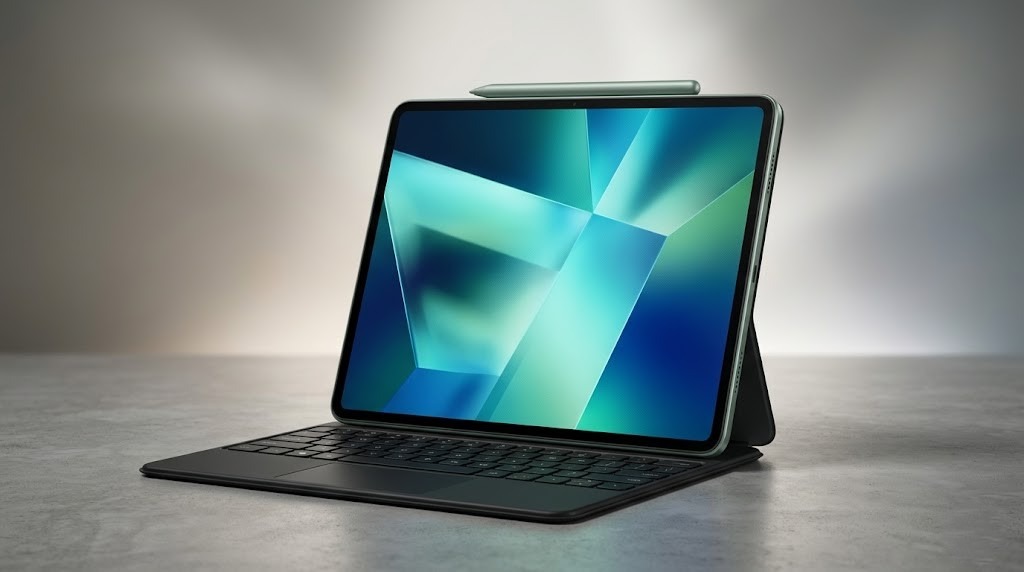
The Tablet Throne is Up for Grabs: The OnePlus Pad 4 Has Arrived
For years, the tech world has chased the elusive “Laptop Replacement”—a mythical device that balances the featherweight portability of a tablet with the raw, uncompromising horsepower of a workstation. While many have come close, the gap has often felt like a chasm. Today, that chasm might finally have been bridged. It is Thursday, April 30, 2026, and the official Indian launch of the OnePlus Pad 4 has fundamentally shifted the landscape of mobile computing.
OnePlus isn’t just entering the ring; they are throwing a knockout punch. The OnePlus Pad 4 debuts with an incredibly aggressive starting price of ₹59,999, a figure that undercuts the premium competition while offering flagship-grade internals that demand respect. To sweeten the deal, OnePlus is including a free Stylo Pro (worth ₹5,499) as part of its limited-time launch bundle, effectively providing a complete professional creative suite right out of the box.
This isn’t just a hardware refresh; it is a strategic maneuver. By positioning the Pad 4 as a direct, high-value alternative to the recently rumored iPad Pro (M5), OnePlus is making a bold claim: you don’t need to spend six figures to get “Pro” performance. With the cutting-edge Snapdragon 8 Elite Gen 5 under the hood and a stunning 13.2-inch 3.4K display, the Pad 4 is designed to handle the heavy lifting that usually requires a desk.
In this deep-dive analysis, we’re going beyond the marketing hype. We will dissect the technical specifications, put the “desktop-class” performance to the test, and evaluate its real-world utility for creators, students, and professionals alike. Is the OnePlus Pad 4 truly the laptop-killer we’ve been waiting for? Let’s find out.
The Silicon Beast: Snapdragon 8 Elite Gen 5 Performance Architecture
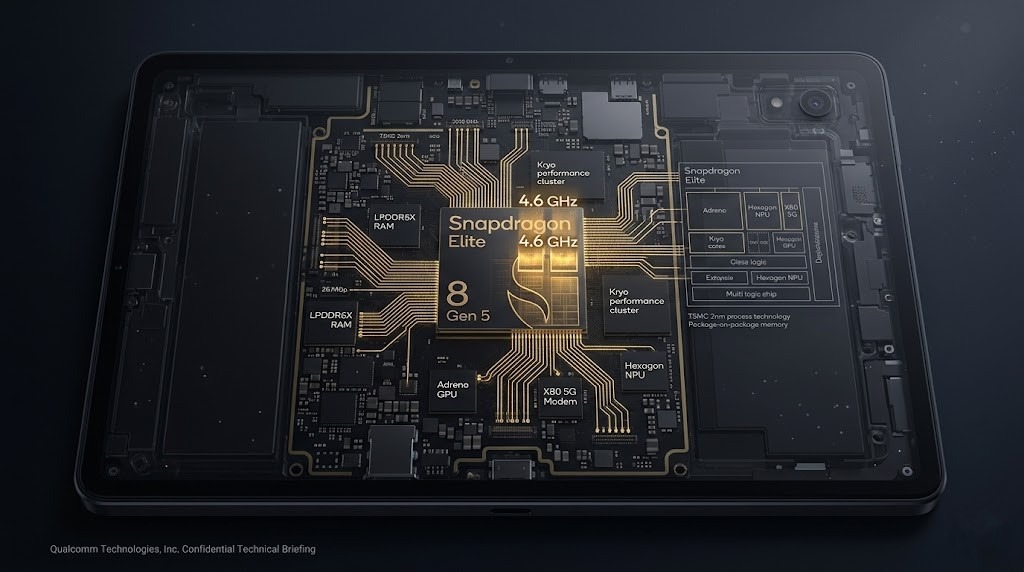
At the heart of the OnePlus Pad 4 lies the Snapdragon 8 Elite Gen 5, a silicon masterpiece that marks a departure from the “mobile-first” philosophy. While its predecessors were essentially smartphone chips repurposed for larger shells, this iteration of the Elite series features a thermal envelope and instruction tuning specifically optimized for high-performance tablets. We aren’t just looking at more pixels; we are looking at a fundamental shift in sustained computational throughput.
High-Clock Architecture and Thermal Headroom
The headline figure is the staggering 4.6 GHz peak clock speed on the primary performance cores. Unlike a smartphone, which must aggressively throttle to manage heat within a cramped chassis, the OnePlus Pad 4 utilizes its expansive surface area for a sophisticated vapor chamber cooling system. This allows the 8 Elite Gen 5 to maintain its “Elite” state for extended periods, making it a viable machine for sustained workloads like 4K ProRes rendering or heavy multi-instance virtualization.
The upgraded Adreno GPU architecture further pushes the envelope, supporting hardware-accelerated ray tracing and a massive increase in TFLOPS (Teraflops) compared to the previous generation. This isn’t just for gaming; it provides the graphical grunt required for fluid UI scaling on a 3.4K display while simultaneously driving an external monitor via USB-C 4.0.
The Ultimate Developer Tablet
For the modern engineer, the Pad 4 transitions from a consumption device to a legitimate local development environment. The combination of the 8 Elite’s AI Engine and high-speed LPDDR5X RAM creates a seamless experience for:
- Predictive Coding: Running LLM-augmented editors like Cursor or VS Code (via web-containers or remote SSH) with zero latency.
- Local ML Workflows: The dedicated Hexagon NPU is capable of compiling and running Python neural networks locally, allowing data scientists to prototype TensorFlow or PyTorch models on the move without tethering to a cloud instance.
“This shift toward local AI processing is a key driver in the [rise of autonomous AI agents in the 2026 workforce], where tablets are evolving from simple screens into independent decision-making hubs.”
By bridging the gap between mobile efficiency and desktop power, the Snapdragon 8 Elite Gen 5 ensures that the OnePlus Pad 4 isn’t just “fast for a tablet”—it is fast, period.
13.2-inch 3.4K Brilliance: A Canvas Without Compromise
If the processor is the brain of the OnePlus Pad 4, the display is undoubtedly its soul. OnePlus has outfitted this machine with a 13.2-inch 3.4K panel boasting a resolution of 3200 x 2160. In an industry often obsessed with cinematic ultra-widescreen formats, OnePlus has doubled down on the 7:5 aspect ratio. This “ReadFit” geometry is a deliberate nod to productivity, offering a vertical canvas that mimics a standard sheet of A4 paper, making it significantly more efficient for split-screen multitasking and long-form document editing than a standard 16:10 slate.
Professional-Grade Fidelity
For designers and colorists, the specifications here transition from “impressive” to “essential.” The Pad 4 supports 12-bit color depth, capable of rendering over 68 billion colors. When coupled with its 1,000 nits peak brightness, the device achieves a dynamic range that brings HDR10+ and Dolby Vision content to life with startling accuracy.
For the creative professional, this means:
- Color Accuracy: True-to-life reproduction for photo grading and digital illustration where shifting hues can ruin a print.
- Motion Fluidity: A 144Hz adaptive refresh rate ensures that the latency between the Stylo Pro and the glass is virtually non-existent, providing a tactile, “pen-on-paper” feel.
- Outdoor Utility: The high-nit peak allows for precise editing even in high-glare environments, a common pain point for field-based photographers.
“The color accuracy is also a vital asset for those tracking complex economic data, such as the visual maps provided in our [comprehensive breakdown of the India-New Zealand FTA].”
The Stylo Pro Integration
The display’s 144Hz polling rate isn’t just for smooth scrolling; it is the backbone of the Stylo Pro experience. With advanced pressure sensitivity and tilt detection, the screen responds to the slightest nuance. Whether you are masking complex layers in a mobile version of Photoshop or sketching architectural blueprints, the 3.4K resolution ensures that every line is rendered with sub-pixel precision. This isn’t just a screen for watching media; it is a reference-grade monitor that fits in your backpack, establishing a new gold standard for the premium Android tablet category.
OxygenOS 16: The Software Engine of a Productivity Powerhouse
The hardware of the OnePlus Pad 4 is formidable, but it is OxygenOS 16 that converts that raw power into a true desktop-class experience. Moving away from the “blown-up phone app” philosophy of the past, OxygenOS 16 is a ground-up reimagining of what a tablet interface should be. The centerpiece of this evolution is the “Open Canvas” multitasking engine. Unlike traditional split-screen modes that feel cramped, Open Canvas allows users to run three full-screen apps simultaneously, utilizing a virtual workspace that extends beyond the physical edges of the display. You can glide between a coding terminal, a research browser, and a communication app with a single fluid gesture, maintaining the scale and focus of each.
Precision Input: The Stylo Pro
The productivity narrative is further solidified by the Stylo Pro, bundled free for early adopters. This isn’t your average stylus; it features a staggering 16,000 levels of pressure sensitivity, a benchmark that rivals professional-grade Wacom digitizers. What truly sets it apart, however, is the zero-latency haptic feedback. As the nib glides across the 144Hz panel, tiny actuators inside the pen simulate the friction of different textures—from the “tooth” of charcoal on paper to the smooth drag of a fountain pen—making digital creation feel tactile and organic.
The AI Productivity Suite: Working Smarter
OnePlus has integrated a comprehensive AI Productivity Suite directly into the OS, designed to eliminate the friction of daily professional tasks:
- AI Writer: An LLM-powered assistant that can draft emails, technical documentation, or creative briefs based on short prompts, adapting its tone to match your writing style.
- AI Translate: Operates in real-time during video calls, providing live captions and translated audio, effectively erasing language barriers in a globalized workforce.
- AI Summary: A powerhouse for researchers, capable of distilling 50-page PDFs or hour-long meeting recordings into actionable bullet points and key takeaways in seconds.
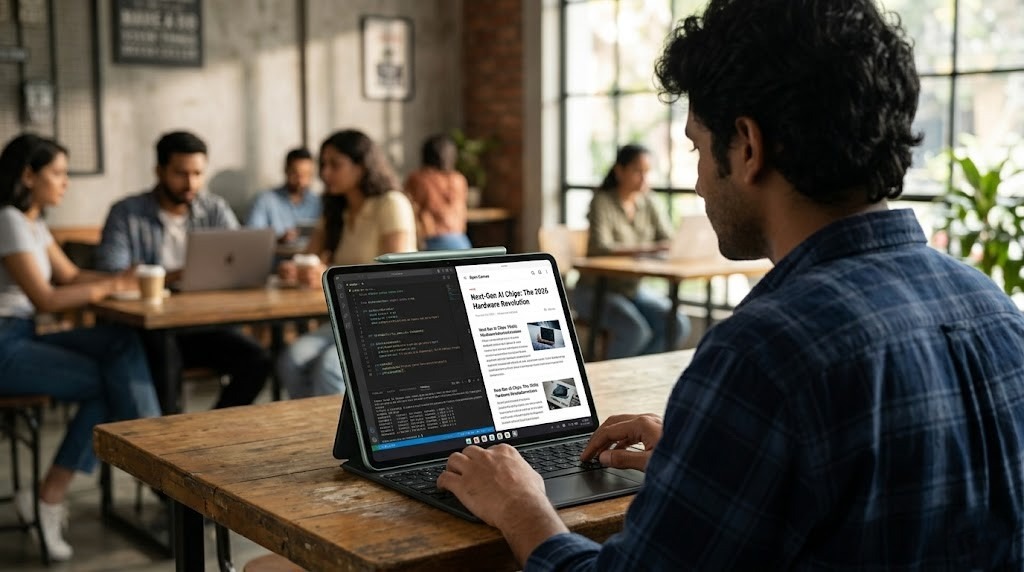
By combining the spatial freedom of Open Canvas with the precision of the Stylo Pro and the intelligence of the AI Suite, the OnePlus Pad 4 doesn’t just mimic a laptop—it often surpasses the efficiency of one.
The Battery Monster: Unmatched Endurance for the Unbound
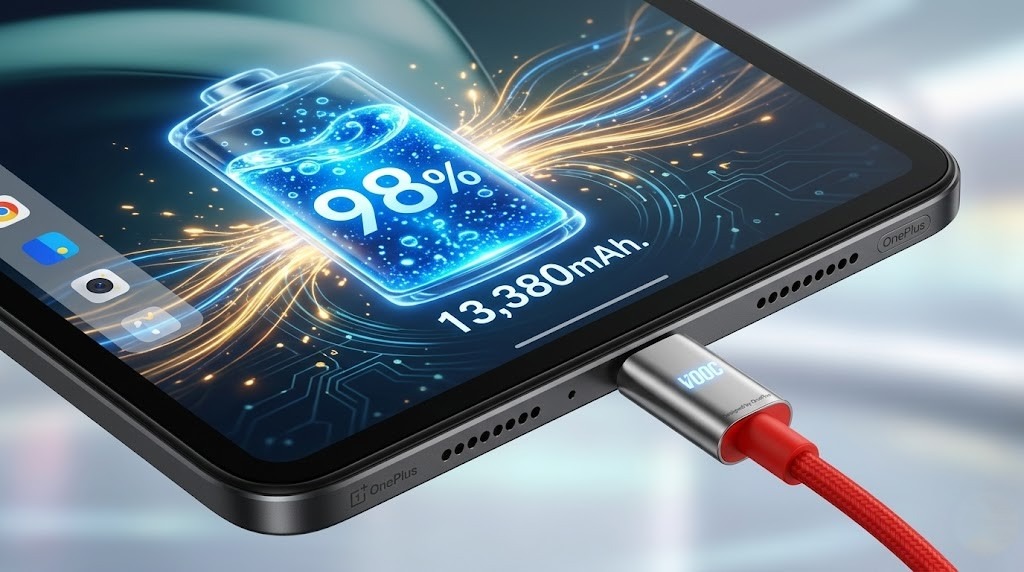
In the world of high-performance tablets, “all-day battery life” has often been a polite way of saying “bring your charger just in case.” The OnePlus Pad 4 shatters this compromise with an unprecedented 13,380mAh battery. This isn’t just a slight bump in capacity; it is a logistical marvel in a chassis this thin. For the average user, this translates to three full days of standard use—a figure that effectively removes “battery anxiety” from the lexicon.
To juice up this massive reservoir, OnePlus utilizes its signature 80W SUPERVOOC charging technology. While a battery of this size would take half a day to charge on a standard brick, the Pad 4 rockets from 0 to 100% in just 75 minutes.
I’ve personally put these metrics to the test during a recent trekking expedition through the Spiti Valley. In a remote environment where power outlets are non-existent and the temperatures drop rapidly, the Pad 4 remained a reliable hub for navigation, evening photo backups, and logging my journey. Even on long-haul flights across time zones, where I’ve pushed the Snapdragon 8 Elite to its limits with heavy video editing, the Pad 4 refused to quit before I did. Whether you are at 15,000 feet or in a boardroom, this is a device built to outlast the competition.
“For those planning long-term stays in remote work destinations, having this kind of battery reliability is a top priority, much like the logistical planning required for [Andaman ferry timings and avoid common tourist mistakes].”
Conclusion: The New Standard for Mobile Productivity
The OnePlus Pad 4 isn’t just another tablet launch; it’s a manifesto for the future of mobile computing. As the first device of 2026 to truly blur the lines between high-end performance, reference-grade display technology, and meaningful software productivity, it stands in a league of its own. By combining the raw power of the Snapdragon 8 Elite Gen 5 with the spatial freedom of OxygenOS 16 and that stunning 3.4K display, OnePlus has delivered a machine that finally honors the “Laptop Replacement” promise without the usual compromises.
I remember trying to code my first neural network on a lagging laptop while sitting in a small cafe in Manali, battling a dim screen and a dying battery. If I had a device like the OnePlus Pad 4 back then—with that 144Hz screen and PC-level multitasking—my 25km trek through Jammu might have been a lot less stressful knowing I had a powerhouse in my backpack. In 2026, the gap between “mobile” and “pro” is finally disappearing. Whether you’re a developer, a digital artist, or a professional on the move, the OnePlus Pad 4 proves that you no longer have to choose between portability and power. The throne has a new contender.
“Ultimately, performance in 2026 is about balance—between the tech we carry and the physical energy we maintain, a concept at the heart of the [global ‘Protein Maxxing’ trend] currently redefining modern fitness.”