

The digital landscape is undergoing its most radical transformation since the launch of the App Store in 2008. For nearly two decades, we have lived in a “fragmented” ecosystem—opening one app to book a flight, another to check the weather, and a third to message a friend.
As we cross into mid-2026, that era is ending. The “Traditional App” is being replaced by the AI Agent, a paradigm shift that moves us from tools we use to partners that act.
Beyond the Chatbot: Understanding AI Agents
To understand this shift, we must distinguish between the “Chatbot” era (2023-2024) and the “Agent” era (2025-2026).
A chatbot is reactive. You provide a prompt, and it provides a text-based response. It talks, but it doesn’t “do.” In contrast, an AI Agent is proactive. It possesses “agency”—the ability to use tools, browse the web, access your calendar, and execute multi-step tasks without human intervention.
The secret sauce behind this is the Agentic Workflow. Instead of a single LLM trying to guess a final answer in one shot, agentic workflows allow the AI to iterate. An agent will draft a plan, execute the first step, evaluate the result, and self-correct. If you tell a 2026 agent to “Plan a business trip to Tokyo,” it doesn’t just list flights; it checks your budget, books the seat, reserves a hotel near your meeting, and populates your calendar.
Hardware Evolution: Local Power for Local Action
The rise of agents has necessitated a hardware “arms race.” Large Language Models (LLMs) originally lived in the cloud, but the latency and cost of cloud-based agents made them impractical for real-time tasks.
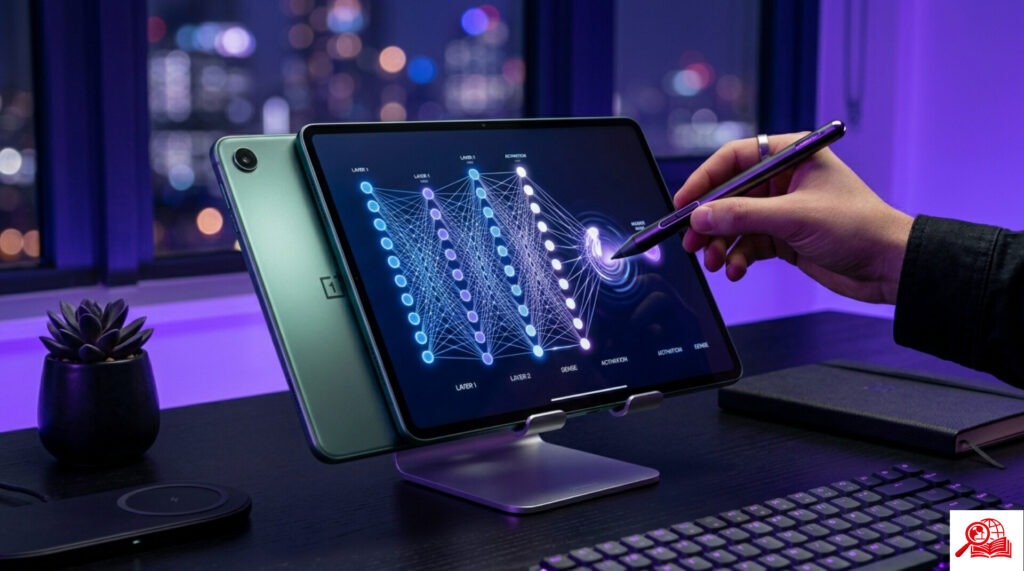
Leading the charge in this hardware evolution are two major releases this month. The OnePlus Pad 4, launching April 30, and the recently debuted Redmi A7 Pro are no longer just “tablets” or “phones”—they are AI workstations. Both devices feature dedicated NPU (Neural Processing Units) specifically designed to run “Small Language Models” (SLMs) locally.
By moving the “brain” of the agent onto the device, these manufacturers have eliminated the “thinking” lag. When your OnePlus Pad 4 manages your emails, the data never leaves the silicon. This local processing power is what enables agents to interact with your device’s OS at a kernel level, allowing them to “see” what is on your screen and click buttons on your behalf.
The Developer Shift: From Coding to ‘Vibe Coding’
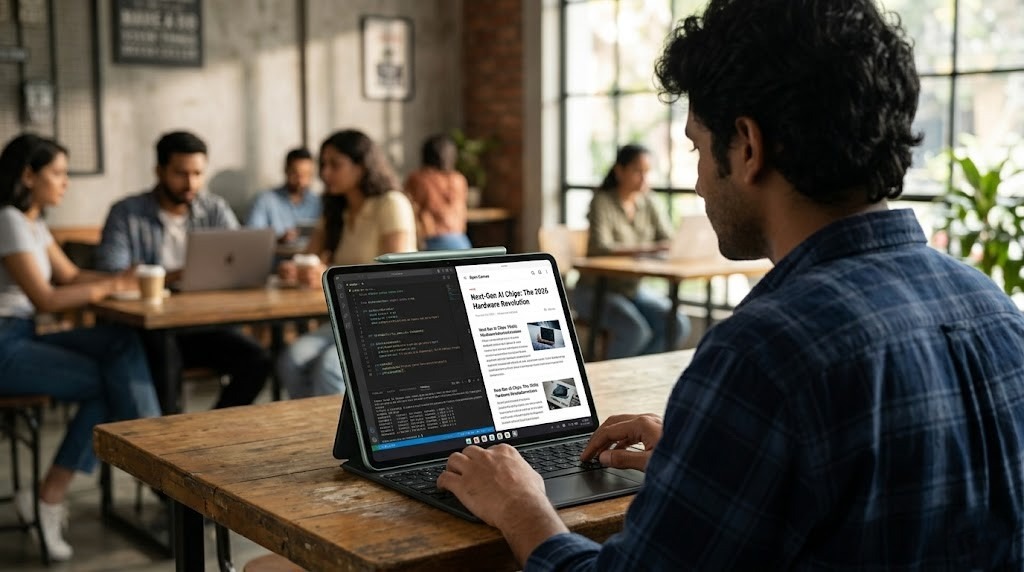
Perhaps the most disruptive change is who is building these agents. In the traditional app era, you needed a team of backend engineers and UI/UX designers to bring an idea to life. In 2026, we have entered the age of “Vibe Coding.”
Tools like Cursor have evolved from mere code editors into “Agentic Orchestrators.” Developers—and increasingly, non-technical “builders”—no longer write every line of syntax. Instead, they describe the logic and the vibe of how an agent should behave.
Because these tools can now handle complex backend integrations automatically, an individual can build a “Personal Financial Agent” in a single afternoon. We are seeing a massive shift away from “Mass-Market Apps” toward “Bespoke Agents” tailored to the specific needs of one person.
Privacy & Security: The Rise of On-Device AI
For years, the trade-off for AI convenience was total data surrender. To get smart suggestions, you had to send your life to the cloud. 2026 is the year that trade-off expired.
The “On-Device AI” trend is driven by necessity. If an agent is to manage your bank accounts or private health data, it cannot reside on a corporate server. Modern agents use Federated Learning and local storage. Your Redmi A7 Pro learns your habits, but that “learning” is encrypted within the hardware’s secure enclave.
This shift has effectively killed the “Data-for-Services” business model. Privacy is no longer a premium feature; it is the default infrastructure of the agentic era.
The Pros and Cons of the Agentic Era
| Feature | AI Agents (2026) | Traditional Apps (2010-2024) |
| Interaction | Natural Language/ Intent-based | Tapping/Scrolling/ Menus |
| Effort | Autonomous (Executes for you) | Manual(You do the work) |
| Integration | Deep OS-level synergy | Isolated “Silos” |
| Privacy | Local/On-device processing | Cloud |
| Learning | Self-correcting/ Adaptive | Static/ Update-dependent |
The Risks:
- Over-reliance: Users may lose the ability to perform basic digital tasks.
- Agent Conflict: Two agents (e.g., your shopping agent and your budget agent) may have conflicting goals.
- Security: If an agent has “agency” to spend money, the stakes of a hack are significantly higher.
Top 3 Agentic Tools of 2026
- Auto-GPT 5.0 (Mobile Edition): The gold standard for cross-platform task execution. It lives in your OS and manages everything from your WhatsApp replies to your Uber bookings.
- Cursor (Pro-Builder): The tool that turned the world into developers. Its “Vibe Coding” interface allows for the creation of complex agents through natural language dialogue.
- Lumina OS: The first “Zero-App” operating system. It features no icons; instead, it presents a single, fluid interface that morphs based on what your agent predicts you need next.
Future Outlook: The “Zero-App” Smartphone
What does the endgame look like? Imagine a smartphone screen with no icons. No folders, no red notification badges, and no “app fatigue.”
The “Zero-App” phone is a fluid, conversational interface. When you pick up your phone, it doesn’t show you a grid of software; it shows you a summary of what has been done.
- “I’ve rescheduled your 10 AM, drafted the report, and ordered your usual coffee. It will be ready when you pass the shop in 5 minutes.”
In this future, “Apps” become background services—invisible APIs that agents call upon. We are moving from a world of “Software as a Service” to “Action as a Service.”
The transition will be jarring for some, but by the end of 2026, looking for an “app” to do something will feel as archaic as looking for a physical map to find a destination. The agents haven’t just arrived; they’ve taken over.
“We spent the last decade learning how to use our devices; in 2026, our devices have finally learned how to use themselves. The ‘App’ was a middleman we no longer need. As the icons vanish from our screens, the only question left is: What will you do with the time your Agent just gave back to you?“





[…] shift toward local AI processing is a key driver in the [rise of autonomous AI agents in the 2026 workforce], where tablets are evolving from simple screens into independent decision-making […]