
The silence that followed the afternoon of March 12 was heavy, almost ringing. For years, life had been measured in the rhythmic scratch of ballpoint pens against rough paper and the low hum of ceiling fans in coaching centers. When the final bell echoed through the hallway, it didn’t feel like a victory lap; it felt like stepping out of a pressurized cabin into the thin, quiet air of a high altitude.
For the longest time, my identity was defined by three specific pillars of science and logic. I wasn’t a person so much as I was a set of functions to be solved. My schedule was a rigid architecture of formulas and constants, leaving no room for the “unnecessary.”
The Weight of a Single Label
There is a particular kind of claustrophobia that comes with being told you must be exactly one thing. We are conditioned to believe that our value lies in a singular trajectory—usually ending in a cubicle, a terminal, or a title like “Software Engineer.” That narrow path felt like a cage, bars made of high-level syntax and optimization problems. It suggested that if I spent an hour studying the brushstrokes of a painting or the meter of a poem, I was somehow leaking productivity.
The Rise of the Renaissance Student
But in that post-exam silence, a different idea began to take shape: the Renaissance Student.
Why should logic and lyricism be mutually exclusive? I realized that I didn’t want to just build systems; I wanted to understand the ghosts that haunt them. To be a Renaissance Student is to refuse the binary. It is the ability to:
- Write clean, elegant code that solves a complex problem.
- Deconstruct a Dostoevsky novel, finding the raw human suffering hidden beneath the prose.
- Bridge the gap between the cold efficiency of a machine and the messy, beautiful chaos of the humanities.
We aren’t meant to be specialized cogs in a machine. We are meant to be polymaths—hybrid thinkers who can debug a script in the morning and lose themselves in a philosophy text by candlelight. The blank canvas isn’t a void to be feared; it’s the first place where all these different versions of ourselves finally get to meet.
The Strategic Pivot: Why “Lifestyle” is the New Foundation
The silence of the post-exam hall was eventually replaced by the rhythmic crunch of gravel under my boots. If the years of intense study taught me how to focus, it was the 25km Jammu trek and the winding trails of Himachal that taught me how to live.

For a long time, I viewed these excursions through a narrow lens—as a way to burn calories or check a “fitness” box. I was wrong. These weren’t just physical challenges; they were the first strokes on that blank canvas I found after the exams. They represented a fundamental shift from being a passive observer of my own life to being an active architect of it.
Redefining Health in 2026
In the current landscape of 2026, the old definitions of wellness feel increasingly hollow. We’ve moved past the era where health was measured solely by the circumference of a bicep or the speed of a 5k sprint. Those are metrics; they aren’t a life.
Today, true health is found in the strategic choice of curiosity over comfort. * The Comfort Trap: Staying within the air-conditioned familiarity of a routine, a screen, and a predictable path.
- The Curiosity Choice: Pushing into the thin air of the mountains, engaging with uncomfortable ideas, and maintaining the stamina to explore both the physical world and the intellectual one.
“A lifestyle isn’t what you do once a week at the gym; it is the sum of the moments you choose to be uncomfortable for the sake of growth.”
Launching the Lifestyle Pillar
This blog is no longer just about the “how-to” of technical skills or the “what” of academic success. Today, I am officially launching the Lifestyle Pillar.
This category exists to bridge the gap between the coder and the trekker. It’s for the Renaissance Student who understands that a sharp mind requires a resilient body and a spirit that refuses to settle. We will explore how movement, travel, and the deliberate pursuit of adventure aren’t distractions from our goals—they are the fuel that makes those goals worth achieving.
Welcome to the new era of the blog. Let’s choose curiosity.
The High-Tech Servant: Reclaiming the Human Margin
In the old paradigm, more technology usually meant more noise. We were told that being “tech-savvy” meant spending more hours tethered to a desk, debugging strings of logic until our eyes glazed over. But in 2026, the narrative has flipped. Technology has finally matured into what it was always meant to be: a powerful servant rather than a demanding master.
The goal isn’t to live without tech, but to use it as a force multiplier that buys back our most precious commodity—time.
The Architecture of Compression
My workflow has undergone a radical transformation thanks to a few specific “force multipliers.”
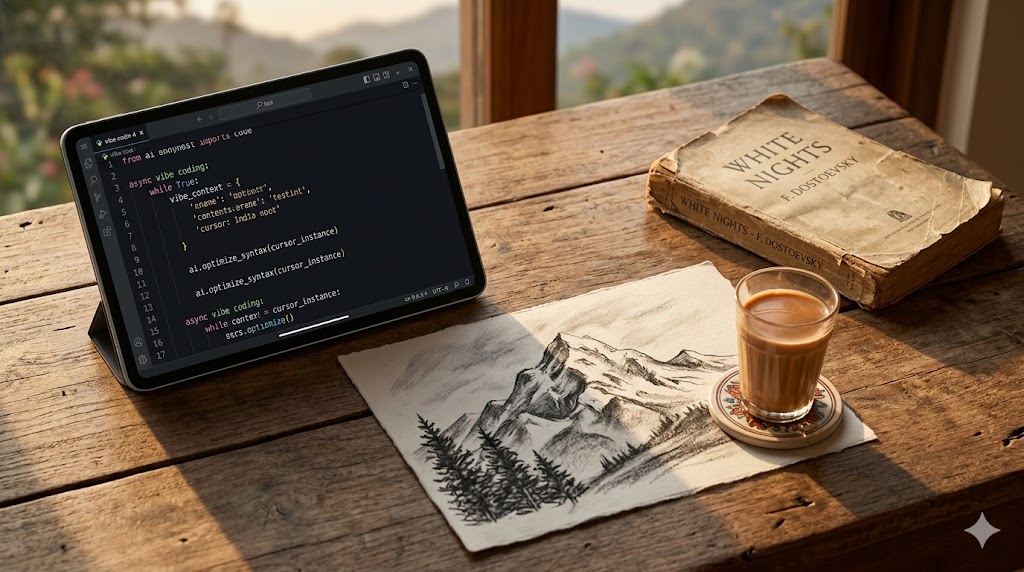
- The OnePlus Pad 4: With its seamless integration and tactile fluidity, it has turned every coffee shop and mountain base camp into a functional satellite office. It’s no longer about being “at” work; it’s about having the power to work from anywhere without the friction of heavy hardware.
- “Vibe Coding” with Cursor: This is the real game-changer. We’ve entered the era of natural language programming where I can “vibe” out a concept and let Cursor handle the heavy lifting. By shifting from manual syntax entry to high-level architectural thinking, I’ve seen my development time compress by nearly 60%.
From Syntax to Soul
When AI handles the “how”—the grueling, repetitive syntax that used to consume my nights—it leaves me with an abundance of the “why.” This is what I call Mental Bandwidth.
For years, the sheer cognitive load of keeping up with frameworks left no room for anything else. Now, because the machine is doing the grunt work, my brain has the space to breathe.
We use AI to solve the logic so that we can use our humanity to solve the meaning.
Because I’m not stuck in a terminal for twelve hours, I have the energy to pick up a book on existentialism, study the nuances of Renaissance art, or plan that next trek into the Himalayas. Tech has cleared the weeds, revealing a path toward the things that actually make us human.
The Philosophy of the Tool
If your tools aren’t making your life simpler, you aren’t using them; they are using you. In this new Lifestyle pillar, we treat tech as a high-speed engine that gets us to our destination faster—the destination being a life lived with curiosity, presence, and a deep connection to the world outside the screen.
We code so we can live. We automate so we can explore. We use the OnePlus Pad 4 and Cursor not just to be “productive,” but to be free.
The New Frontier: Discipline, Sentiment, and Geometry
The “blank canvas” I discovered after the exams isn’t just a space to rest; it’s a space to build. But this time, I’m not building circuits or sorting algorithms—I’m building a more complex version of myself. My new personal challenges aren’t about optimization; they are about immersion.
The Sentimental Education: “White Nights”
I’ve spent years training my brain to appreciate the elegance of a proof, but I’ve recently turned toward a different kind of precision: the precision of human emotion. I’ve started with Fyodor Dostoevsky’s White Nights.
In the past, I might have dismissed “sentimental literature” as inefficient or soft. Now, I see it as a necessary map for the interior world. Dostoevsky captures the “Dreamer” with the same clinical accuracy a physicist uses to describe a particle in motion. I’ve realized that understanding the loneliness of a St. Petersburg night is just as vital as understanding the laws of thermodynamics. It’s why I’ve committed to the 100-Novel Challenge—a strategic deep-dive into the canon of world literature to decode the human condition.
The Physics of the Mudra
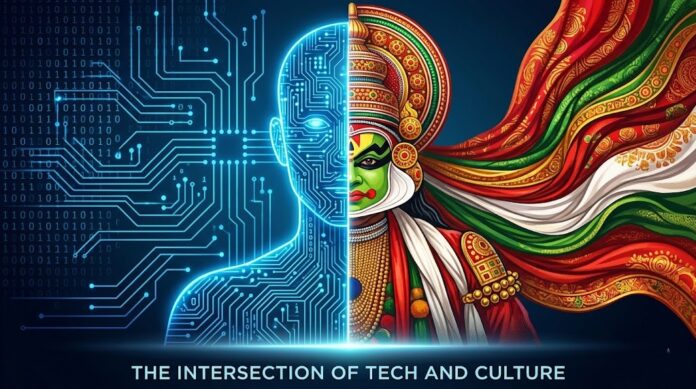
Perhaps the most surprising pivot is my newfound interest in the discipline of Kathakali or Bharatanatyam. To an outsider, classical Indian dance looks like pure art. To me, it looks like applied geometry.
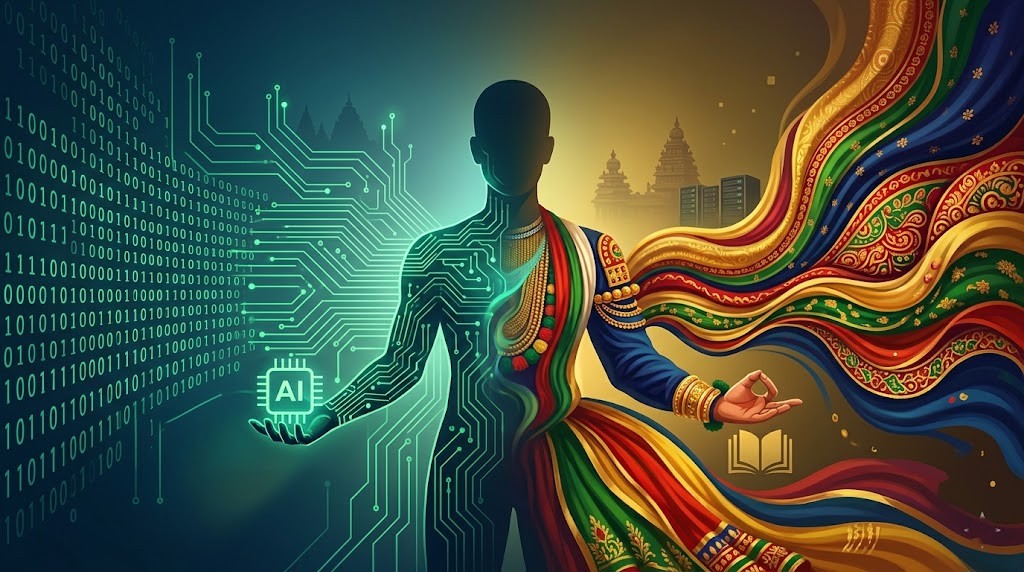
The connection to my roots in science is undeniable. When you strip away the makeup and the music, these dance forms are built on:
- Symmetry and Vectors: The precise positioning of the limbs creates geometric shapes that must be held with absolute structural integrity.
- Angular Velocity: The turns and transitions follow the same laws of torque and momentum I once solved for in mechanics.
- Rhythmic Logic: The tala (meter) is a complex mathematical grid. Executing a footwork pattern is, in many ways, like executing a perfectly timed recursive function.
Same Brain, Different Input
I’ve realized that the part of my brain that used to crave the elegance of a physics derivation is the same part that is now satisfied by the structural logic of a novel’s plot or the rigid discipline of a dance posture.
The Renaissance Student doesn’t abandon logic; they find new places to apply it. Whether I am analyzing the narrative arc of a Russian masterpiece or mastering the mathematical precision of a mudra, I am still seeking the same thing: order within chaos.
Art is not the opposite of science; it is the final frontier where science becomes lived experience.
By taking on these challenges, I’m proving that the discipline learned in the lab can be the foundation for a life lived in the theater, the library, and the mountains. The goal isn’t just to be “well-rounded”—it’s to be complete.
The Ultimate Portfolio: Diversifying the Soul
In the world of finance, we are taught the power of compounding. We watch a stock like Kissht or a well-hedged index and measure success by the upward trajectory of a valuation curve. We call it “growth.” But as I stand on this side of the boards, looking out at the vast, unscripted horizon of 2026, I’ve realized that financial equity is only half the ledger.
It is time to start talking about the Lifestyle Portfolio.
While your market holdings might grow in value, your lifestyle portfolio grows in character. A stock can crash, and a currency can devalue, but the “dividends” of a sunset watched from a Himachal peak, the “compounding interest” of a 100-novel challenge, and the “liquidity” of a mind that can pivot from Python scripts to Dostoevsky—these are assets that no market volatility can touch.
The Danger of the One-Dimensional Asset
Relying on a single skill set is like putting your entire net worth into a single, speculative ticker. It’s risky, it’s fragile, and frankly, it’s boring. Being “just a coder” or “just an engineer” is a form of intellectual poverty.
I am inviting you to stop being a one-dimensional asset. Diversify your existence. Let the logic of your technical craft provide the floor, but let your curiosity for art, movement, and philosophy provide the ceiling. Join me in this Renaissance journey where we refuse to choose between the machine and the muse.
The blank canvas is waiting, and the ink is yours.
Don’t just build a career; build a life worth writing about.