


The Ground Has Shifted — And Most Students Haven’t Looked Down
Here’s something uncomfortable to sit with: right now, thousands of Indian engineering students are hunched over laptops, grinding through DSA problems, memorizing OOP patterns, and building to-do list apps they’ll never deploy — while the actual architecture of the tech industry is being physically reconstructed beneath their feet.
Not metaphorically. Literally.
The cranes are going up. The fiber is going in the ground. The cooling towers are being engineered. And the companies doing it — AWS, Google, Microsoft, Nvidia — are pouring capital into India at a scale that hasn’t happened since the post-liberalization telecom revolution of the 1990s.
Software engineering isn’t disappearing. But the students who only know how to type code on a screen are about to discover that an entirely different class of engineer is being hired — and paid — at a premium they weren’t expecting. India isn’t just writing the software that runs the cloud anymore. India is becoming the cloud.
That realization should feel like cold water to the face. Because the window to get ahead of this curve is open right now — and windows like this don’t stay open forever.
The Policy Earthquake: Why ₹167B–₹200B Is Flowing In Right Now
Every gold rush needs a trigger. For India’s data center explosion, that trigger was pulled in the Union Budget 2026.
In what analysts are already calling one of the most structurally significant fiscal decisions in modern Indian technology policy, the government announced a long-term tax holiday extending to March 31, 2047 — applicable to foreign cloud and hyperscale companies that route significant global operations through Indian data centers. Two decades of legal and fiscal certainty, locked in by statute.
This is not a minor incentive. In the infrastructure investment world, “certainty” is worth more than almost any subsidy. When a company like AWS is evaluating whether to commit $10 billion to building physical infrastructure in a country, the single biggest risk it models is policy reversal — a new government, a sudden regulation change, an unexpected tax regime. The 2047 horizon essentially eliminates that calculation. It tells the CFO in Seattle: build here, and you’ll be protected longer than most of your senior engineers will be employed by us.
The floodgates opened almost immediately.
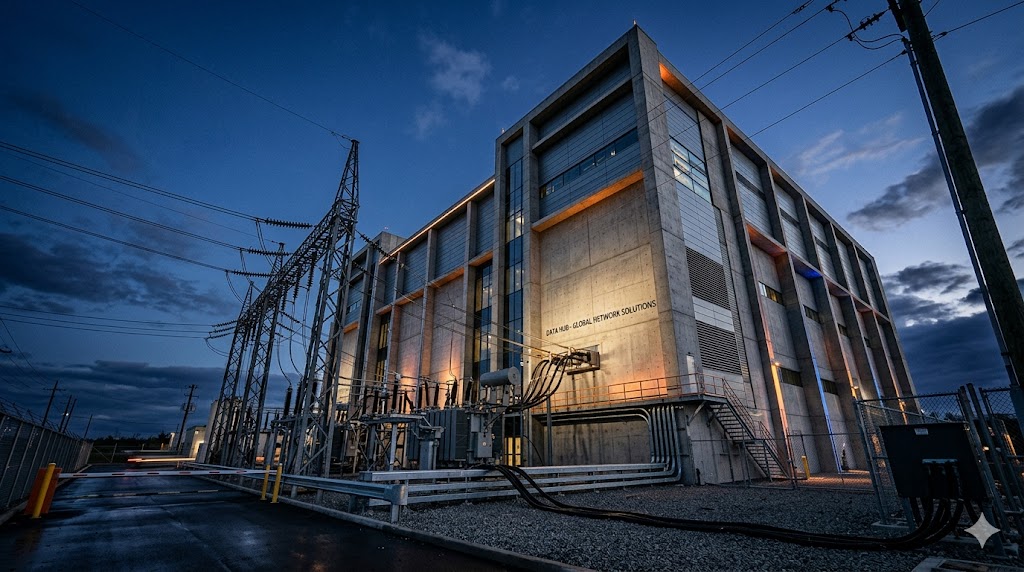
Estimates from infrastructure analysts place the incoming wave of hyperscale investment between $167 billion and $200 billion over the next decade — from AWS, Microsoft Azure, Google Cloud, and Nvidia. These aren’t exploratory pilots. These are foundation-pour, steel-beam, 10,000-square-meter facility commitments.
Nvidia CEO Jensen Huang framed it perhaps most starkly during his visits to India this year, stating that AI infrastructure has become as foundational to modern civilization as water and electricity. Not as a marketing line — as a structural observation about what economies will require to remain competitive in the 2030s. Countries that physically host the compute win the economic leverage. Countries that only consume it remain dependent.
India just decided, with legal permanence, which category it wants to occupy.
The Engineering Problem Nobody’s Teaching in Classrooms
Here’s where things get technically interesting — and where the real engineering frontier opens up.
Most computer science curricula are still built around a world of CPU-based server architectures: general-purpose processors, conventional rack-mounted servers, air-cooled data halls, predictable linear scaling. That world is not gone, but for AI workloads, it is completely, structurally inadequate.
Training a large language model or a vision AI system doesn’t run like a web server. It runs like a sustained nuclear reaction. A single GPU training cluster for a frontier AI model may draw 40 to 80 megawatts continuously — roughly equivalent to the power consumption of a small Indian city. The thermal output is proportional. The networking requirements are unlike anything traditional enterprise IT ever demanded: thousands of GPUs must communicate with each other at near-zero latency across high-speed interconnects like InfiniBand or 400G Ethernet, or the training job fails in ways that are maddeningly hard to debug.
This creates a cascade of engineering challenges that simply didn’t exist five years ago:
Power density is the first wall. Traditional data centers were designed around 5–10 kilowatts per rack. Modern GPU clusters demand 50–100+ kilowatts per rack. You cannot retrofit an old server farm for this. You need entirely new facility designs, new electrical infrastructure, new relationships with state power utilities, and often direct substations built specifically for the campus.
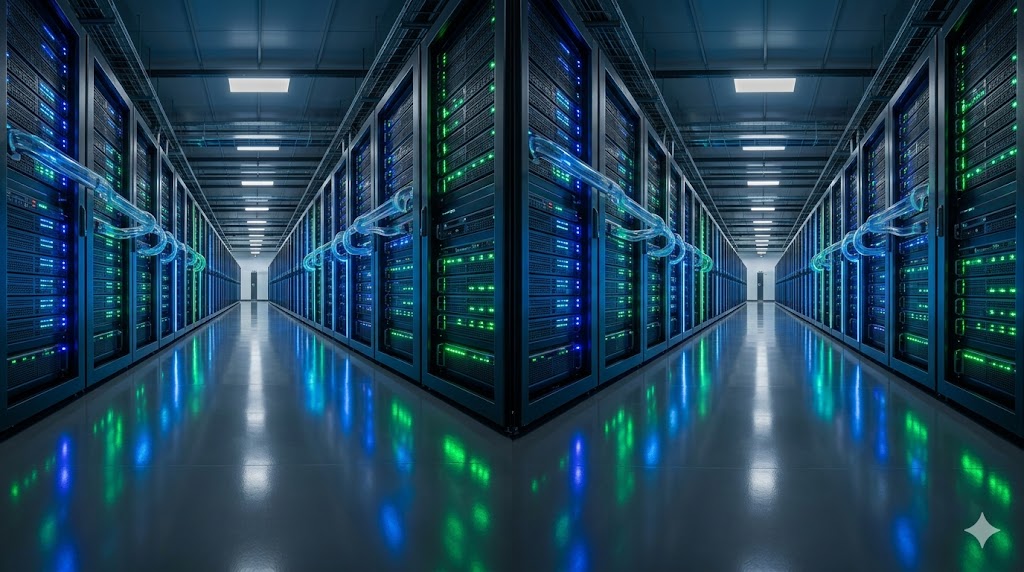
Cooling architecture becomes the defining constraint. Air cooling — the default for decades — fails at these densities. The industry has made a structural, irreversible shift toward high-density liquid cooling: direct-to-chip cold plates, immersion cooling tanks, rear-door heat exchangers. Engineers who understand thermodynamics and fluid dynamics in server environments are suddenly among the most in-demand specialists on the planet.
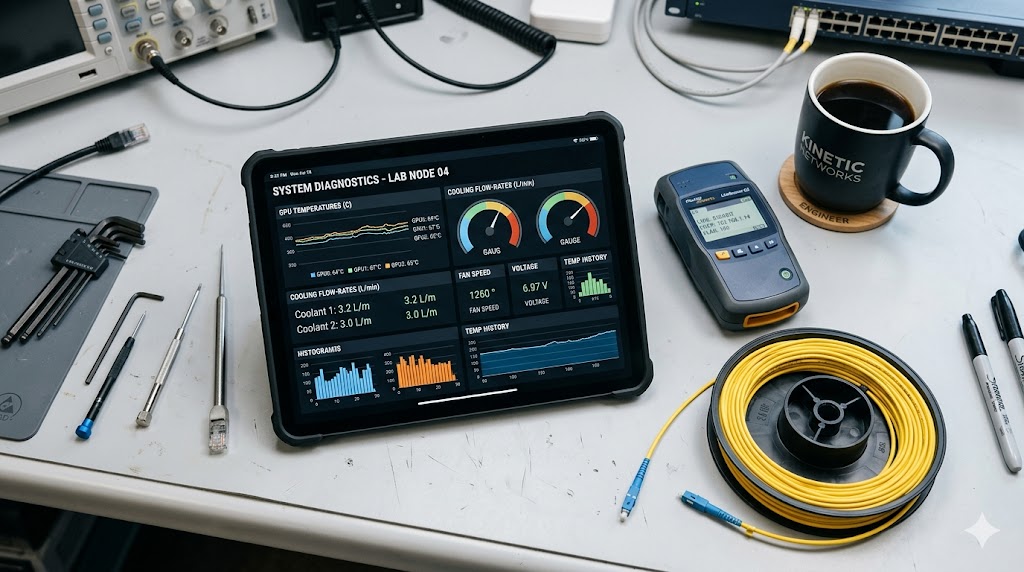
Fiber-optic middle-mile transmission is the circulatory system. A hyperscale GPU cluster generates and consumes data at rates that require purpose-engineered optical fiber networks connecting the facility to internet exchange points, undersea cable landing stations, and other regional data centers. Building, managing, and optimizing this middle-mile infrastructure is its own discipline — one that intersects civil engineering, optical physics, and network architecture.
Grid integration is perhaps the most underappreciated challenge. When a single data center campus draws the power of a small city, the local electrical grid must be engineered to absorb demand spikes without cascading failures. This means working with DISCOM operators, integrating renewable power sources, and building on-site battery storage systems that can buffer millisecond-level power fluctuations that would otherwise corrupt active GPU training jobs.
None of this is taught in a standard B.Tech curriculum. All of it is hiring right now.
The Jobs Are Real, the Locations Are Specific, and the Gap Is Enormous
Let’s put geography and numbers to this.
Noida has already anchored one of the largest single infrastructure investment announcements in UP’s history: a ₹2 lakh crore commitment that the state government projects will generate more than 50,000 direct and indirect jobs over the next five years. These are not vague projections — land acquisitions are underway, environmental clearances are moving, and preliminary facility construction has begun.
Navi Mumbai is emerging as the preferred hyperscale hub for western India, positioned close to undersea cable landing points and benefiting from Maharashtra’s aggressive data center policy. Chennai is rapidly becoming the southern anchor, already home to multiple Tier-III and Tier-IV facilities and favored for its coastal fiber connectivity to Southeast Asia. Hyderabad and Pune are scaling their existing tech infrastructure bases into compute-dense campus environments.
But the more interesting story — and the one students outside metros should pay close attention to — is the Tier-2 and Tier-3 city expansion. Land costs, power tariffs, and water availability (critical for cooling systems) often make secondary cities economically superior for edge and regional data center deployment. Locations like Bhopal, Coimbatore, Nagpur, and Visakhapatnam are now actively being evaluated by regional operators.
The skills gap across all these locations is acute and specific. The industry isn’t struggling to find developers who can write Python. It’s struggling to find engineers who understand how the physical layer works — people who can sit at the intersection of software and hardware and make both perform under real infrastructure conditions.
The three areas where you can build a competitive edge right now:
1. Cloud Architecture Certifications
AWS Solutions Architect, Azure Administrator, and Google Cloud Professional Cloud Architect certifications have moved from “nice to have” to baseline requirements for roles in hyperscale deployment teams. More importantly, understand why the architecture decisions exist — the tradeoffs between compute, storage, and networking tiers aren’t arbitrary; they’re engineering responses to cost and latency physics.
2. High-Performance Computing Clusters
Learn how GPU clusters are assembled and managed. Study CUDA programming, MPI (Message Passing Interface), SLURM workload management, and the basics of InfiniBand networking. Understand what makes a distributed training job fail at 3 AM and how to build monitoring systems that catch it before the model checkpoint corrupts. This knowledge set is rare and compensated accordingly.
3. Linux Systems and Edge-Computing Networking
The operational backbone of every data center runs on Linux. Deep comfort with Linux system administration, kernel tuning, network namespace management, and tools like Ansible, Terraform, and Prometheus is the practical vocabulary of the infrastructure engineer. Layer on networking fundamentals — BGP routing, VXLAN overlays, optical transport protocols — and you become the kind of professional that hyperscale operators will actively compete to hire.
The Architects of the Physical AI Era
Here’s the larger truth underneath all of this.
There is a generation of tech professionals currently being minted who will spend their careers entirely inside abstraction layers — writing code that runs on infrastructure they’ve never seen, optimizing systems they don’t understand at the physical level, and remaining permanently dependent on engineers who do.
And then there will be another kind of engineer.
The kind who understands that behind every API call is a fiber photon, behind every model inference is a GPU drawing 700 watts, and behind every cloud region is a building full of liquid-cooled racks sitting on a private substation negotiated with a state electricity board. The kind who can move fluently between a Kubernetes deployment and a conversation about cooling tower capacity. The kind who sees the data center not as invisible infrastructure but as the most consequential physical construction of the early 21st century.
This is exactly the spirit behind the Lifestyle lens we’re expanding on this blog — the idea that being a well-rounded, multi-dimensional thinker is not a soft skill. It is a technical advantage. Understanding the physical systems that power our virtual world isn’t a curiosity for specialists. It is the baseline literacy of the modern tech explorer. The engineers who possess it will design the systems. Everyone else will use them.
India is building the AI era’s physical backbone. The policy is signed. The capital is committed. The cranes are going up in Noida, Navi Mumbai, and Chennai right now.
The Data Center Boom: India’s Future is not a forecast. It’s a construction site.
The only question is whether you show up with a blueprint or watch from the outside.