


The room inside New Delhi’s Bharat Mandapam was already buzzing with high-stakes tension last night, but what happened next caught hundreds of top diplomats and corporate titans completely off guard.
As the U.S. Embassy’s celebration of America’s 250th Independence Day was underway, U.S. Ambassador Sergio Gor stepped up and put his phone on speaker. On the other end, beamed in live, was U.S. President Donald Trump. His voice boomed across the hall, shattering the formal diplomatic air: “I love India… I love the Prime Minister. Modi is great, he is my friend… India can count on me 100%!”
For global markets, that wasn’t just a moment of viral political theater—it was a massive, flashing buy signal.
The Monday Morning Pivot
Going into the weekend, traders were defensive. The atmosphere surrounding U.S. Secretary of State Marco Rubio’s arrival in New Delhi had been weighed down by months of grinding tariff anxieties and a widening trust deficit. But Trump’s raw, direct-dial reassurance completely flipped the script for Monday morning’s trading session.
- The Narrative Shift: Instantly, the dark clouds of a potential trade war evaporated.
- The New Focus: Global capital is suddenly aggressively pricing in a massive, impending bilateral trade deal.
Ambassador Gor followed up the President’s call by confirming that an interim trade pact is on the fast track and expected to be signed “in the next few weeks.” Furthermore, India’s official entry into Pax Silica—the U.S.-led alliance securing the supply chains for the artificial intelligence era—signals a profound tech and economic integration that the market can no longer ignore.
What it Means for the Street
This isn’t just about warm words; it’s about serious capital deployment. Gor revealed that the U.S. mission in India has just taken the number-one spot globally by routing $20.5 billion in new investments into the United States.
As the opening bell rings this Monday, the geopolitical risk premium on Indo-U.S. corridors is collapsing. Investors are pivoting hard away from defensive hedging and charging straight into cross-border tech, defense, and manufacturing plays. The trade war rhetoric is dead; the mega-deal era is officially on.
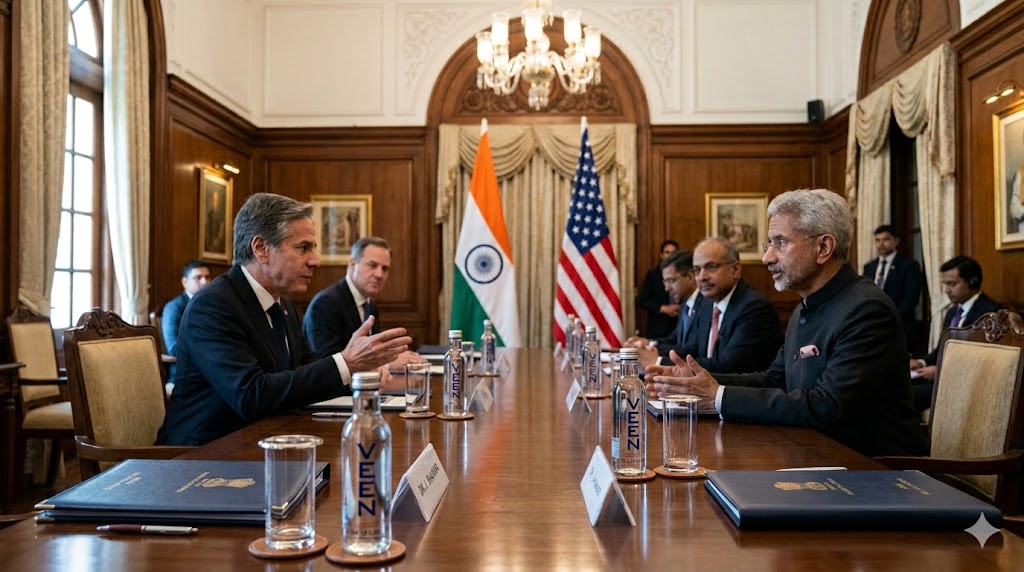
Behind the warm smiles, the personal phone call from President Trump, and the handshakes at Hyderabad House, U.S. Secretary of State Marco Rubio’s high-stakes meetings with Prime Minister Narendra Modi and External Affairs Minister S. Jaishankar weren’t just a polite diplomatic reset. They were a hard-nosed, multi-billion-dollar corporate restructuring of the geopolitical map.
If you peel back the diplomatic boilerplate, the “meat” of this impending trade deal focuses on four core pillars:
- Critical Minerals: Securing the supply chains for lithium, cobalt, and rare earth elements, bypassing traditional single-country monopolies.
- AI Infrastructure & Pax Silica: Integrating India directly into the U.S.-led semiconductor and artificial intelligence architecture.
- Clean Energy: Accelerating the deployment of next-generation solar, nuclear, and green hydrogen technologies.
- Defense Tech: Moving past simple buyer-seller dynamics into co-developing advanced military hardware.
Translating the Jargon: The “Cushion” Effect for Retail Investors
If you are a young retail investor, all of this can sound like abstract macro-mumbo-jumbo. But here is why this specific trade deal actually matters directly to your portfolio, your stock market returns, and your wallet.
Historically, the Indian economy has had a massive Achilles’ heel: crude oil dependency.
India imports over 80% of its crude oil. When global geopolitical tensions flare up—like the ongoing friction in West Asia—crude prices spike. In financial terms, this creates a domino effect: India’s import bill skyrockets, inflation ticks upward, the Reserve Bank of India (RBI) is forced to keep interest rates high to fight that inflation, and high interest rates generally crush stock market valuations. In short, when oil gets volatile, your stock portfolio takes a hit.
This finalized U.S.-India trade deal acts as a strategic shock absorber in three specific ways:
1. Decoupling from the Oil Trap via “Mission 500”
The trade pact aggressively pushes the “Mission 500” initiative, which aims to double bilateral trade to $500 billion by 2030. By securing heavily diversified U.S. energy products (like liquefied natural gas and American energy exports) and co-funding massive clean energy grids, India fundamentally reduces its absolute reliance on volatile Middle Eastern crude. When a geopolitical crisis hits the oil markets, India will have alternative, stable energy baselines.
2. The Tech & Defense Anchor
By cementing India’s place in Pax Silica (the AI and semiconductor alliance) and locking in defense co-production, India transitions from a consumption-led economy to a high-value manufacturing hub.
Why it matters to you: Even if oil shocks cause a temporary dip in general market sentiment, India’s core growth sectors—like electronics manufacturing, defense tech companies, and AI infrastructure—will have guaranteed, multi-year export pipelines locked in with the world’s biggest economy. This creates structurally resilient earnings for Indian corporations.
3. Macro-Stability Equals Capital Inflow
When global markets experience a crisis, foreign institutional investors (FIIs) typically pull their money out of emerging markets and run to the safety of the U.S. Dollar. However, a formalized, ironclad economic alliance with the U.S. signals to global funds that India is a “trusted partner.” This stamp of approval stabilizes the Indian Rupee and keeps foreign capital from fleeing the domestic stock market during global panics.
The Bottom Line
Think of this trade deal as an institutional insurance policy. It doesn’t mean India will completely escape global market storms, but it means the economic foundation is being reinforced with American capital, technology, and alternative energy. For a retail investor, that translates to fewer sleepless nights when global headlines turn ugly, and a far more predictable, tech-driven growth runway for Indian equities.
The diplomatic breakthrough in New Delhi has fundamentally rewritten the risk-reward profile for Indian equities. With U.S. Secretary of State Marco Rubio confirming that a comprehensive, sustainable trade pact is on the verge of completion, and India formally integrated into the U.S.-led Pax Silica alliance, macro uncertainty is rapidly converting into sector-specific tailwinds.
The following concrete investment analysis outlines which sectors are positioned for immediate structural re-rating and why current market conditions offer a premium entry point.
1. Indian Tech & AI Firms: The Pax Silica Multiplier
India’s integration into the Pax Silica initiative and the signing of the India-U.S. AI Opportunity Partnership shifts Indian IT from a low-margin services model to a high-value infrastructure play.
- The Catalyst: The partnership explicitly mandates joint investment in physical AI stacks, secure semiconductor supply chains, next-generation data centers, and advanced compute access.
- Investment Implication: Focus on tier-1 Indian IT giants and specialized engineering R&D firms heavily integrated with U.S. tech ecosystems (e.g., Tata Electronics’ burgeoning semiconductor footprint). As U.S. enterprises look to diversify their tech stacks away from geopolitical flashpoints, Indian firms securing “trusted partner” status will capture a massive share of the global $200 billion AI infrastructure spend.
- Key Metrics to Watch: Order book growth in cloud/AI migration and capital allocation toward local data center joint ventures.
2. Local Defense Manufacturing: From Importers to Co-Developers
The trade deal accelerates the shift away from transactional buyer-seller relationships toward deep, cross-border defense co-production.
- The Catalyst: With Washington looking to anchor its Indo-Pacific security architecture around New Delhi, defense technology transfers are being streamlined. Simultaneously, Indian defense firms have already lined up billions in outbound deployment to secure global supply chains.
- Investment Implication: Domestically listed defense public sector undertakings (PSUs) and private aerospace players are the primary beneficiaries. The structural tailwind here is an insured export pipeline. Companies involved in manufacturing drone tech, advanced munitions, and naval engineering are no longer reliant solely on Indian Ministry of Defence capital expenditures; they are entering the global supply chain of the U.S. defense apparatus.
- Key Metrics to Watch: Growth in export order books and foreign direct investment (FDI) inflows into domestic defense joint ventures.
3. Green Energy Projects: Capitalizing on the “Mission 500” Corridor
The bilateral push to scale total trade to $500 billion by 2030 relies heavily on securing alternative energy infrastructure to decouple from volatile crude markets.
- The Catalyst: Over $60 billion in American capital has been committed to India over the last six months, with a massive chunk earmarked for green hydrogen, utility-scale solar grids, and next-generation energy storage.
- Investment Implication: Pure-play renewable energy developers, smart-grid manufacturers, and green hydrogen pioneers are heavily underpriced relative to their multi-decade growth runways. American institutional capital (FIIs) favoring ESG and infrastructure plays will disproportionately flow into these heavily backed, policy-insulated domestic energy leaders.
- Key Metrics to Watch: Reductions in cost of capital via low-cost international green bonds and capacity commissioning speeds.

The May 2026 Volatility: A Classic “Buy the Dip” Window
The broader Indian market has experienced sharp volatility throughout May 2026. This turbulence was primarily triggered by global macro jitters, historical overhangs from past tariff frictions, and tactical liquidations by short-term funds.
For a retail investor focused on fundamentals, this volatility is a gift. Here is why:
[Global Macro Friction / Tariff Fears] ──> Causes Temporary May 2026 Market Dip
                                                    │
                                                    ▼
[U.S.-India Trade Deal & Pax Silica] ───> Solidifies Long-Term Corporate Earnings
                                                    │
                                                    ▼
Result: Classic "Buy the Dip" Window- Arbitrage on Sentiment vs. Reality: While the retail crowd panics over backward-looking headlines, the institutional reality has pivoted. The structural overhang of a U.S.-India trade war is officially dead.
- Earnings Visibility: The bilateral framework secures visible, multi-year revenue pipelines for the sectors outlined above. A temporary price contraction in May 2026 means you are buying highly resilient, future-ready corporate earnings at a distinct discount.
- The Stamp of Approval: When the formal trade pact is signed in the coming weeks, global funds will aggressively reallocate capital back into India. Buying fundamentally strong stocks during this pre-signing volatility window allows retail investors to front-run the inevitable institutional capital wave.
The Strategy: Avoid speculative momentum. Use any broader market weakness this month to systematically accumulate leading equities across AI infrastructure, defense manufacturing, and green energy corridors. The long-term macroeconomic floor has just been reinforced.
For student investors and young professionals managing their own capital, this geopolitical pivot offers a masterclass in separating market noise from market signal.
When you are building a portfolio with a multi-decade horizon, your biggest enemy isn’t market volatility—it is a lack of perspective. The daily red and green ticks on your screen during May 2026 are temporary noise. What matters structurally is that the tectonic plates beneath the global economy just shifted permanently in India’s favor.
Here is your actionable playbook for navigating this transition:
- Tune Out the Daily Panic: Ignore the sensationalist headlines and short-term liquidations. When the core structural foundation of an economy is reinforced by the world’s largest financial superpower, short-term dips are simply accumulation windows.
- SIP into Strategic Corridors: Do not try to time the exact bottom. Systematically allocate your savings into fundamentally strong businesses within the AI infrastructure, defense, and clean energy ecosystems.
- Invest in Your Knowledge: Treat your portfolio like a business. Understand the order books and international partnerships of the companies you own.
The unique Trump-Modi synergy has transcended standard diplomacy. It has effectively de-risked the Indian economic narrative, shifting it from a defensive emerging market to an aggressive, trusted global tech and manufacturing hub. With American capital locked into India’s growth engine and an ironclad trade pact hitting the fast track, the macroeconomic floor has been decisively raised.
The paradigm has changed, the alignment is real, and the runway is clear. Position your capital where the future is being built, and invest with the absolute certainty that you are witnessing The Trump Call: India’s Economic Leap.