

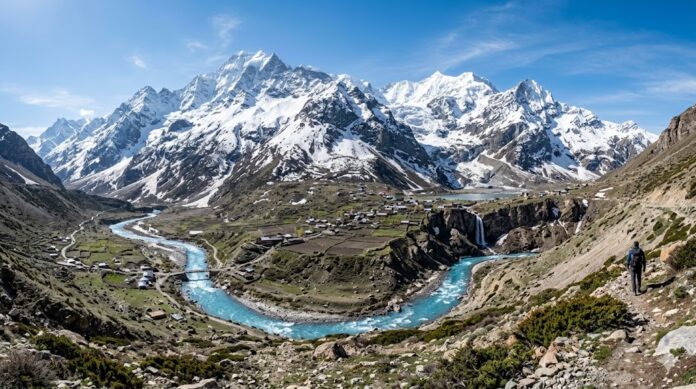
The heat in the plains isn’t just a temperature anymore; it’s a physical weight. By mid-afternoon, the air turns into a static, shimmering haze, and the mercury stubbornly claws its way past 40°C. Your skin feels tight, the asphalt radiates a relentless fever, and every ceiling fan in the city seems to be merely circulating the same exhausted air. In moments like these, the mind doesn’t just wander—it migrates. You find yourself staring at your screensaver, tracing the jagged lines of the Dhauladhars, desperate for a reality that doesn’t involve sweating through your shirt.
The Transition: From Scorched Earth to Alpine Bliss
The magic happens somewhere past Mandi. As the road begins its rhythmic coil upward, the oppressive “yellow” light of the dusty plains begins to cool into a deep, saturated emerald. You roll down the window, and the transformation is instant:
- The Scent: Gone is the smell of hot dust and exhaust, replaced by the sharp, resinous perfume of deodar pines and damp earth.
- The Sound: The rhythmic drone of the AC is swapped for the thunderous, chaotic symphony of the Beas River. It’s a cold sound—a crashing of glacial melt against ancient boulders that promises a chill you can feel in your teeth.
- The First Sight: Then, rounding a sharp bend near Hanogi, the valley opens up. There it is—the first glimpse of a high-altitude peak, its summit draped in a blinding, permanent white that seems defiant against the May sun.
Why May 2026 is the “Golden Window”
While the rest of the world is hunkering down under heatwaves, May 2026 has carved out a unique sweet spot for trekkers heading toward the Bara Bhangal or Hampta Pass.
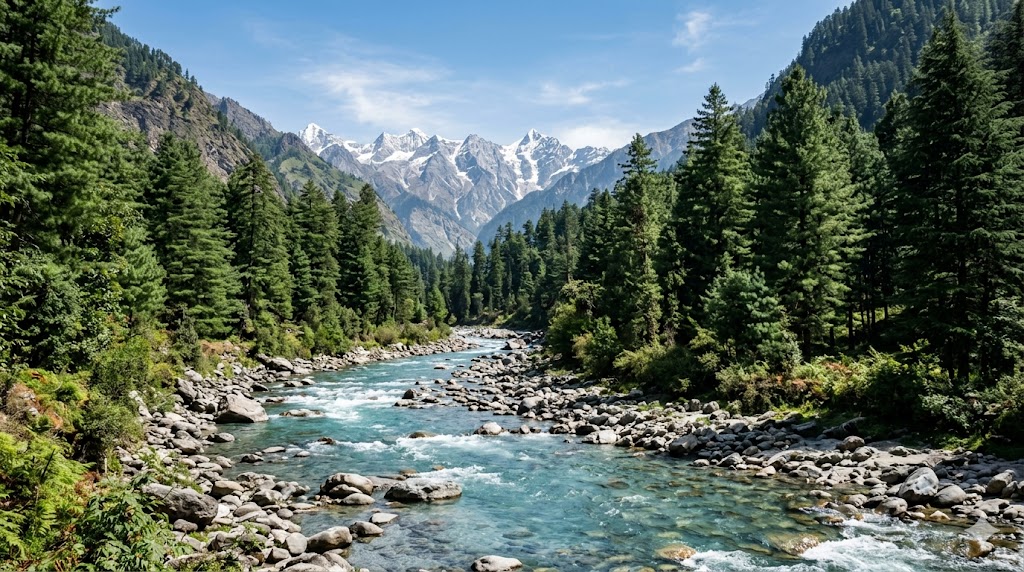
- The Snow-Line Paradox: Following an unusually heavy late-winter cycle, the high passes are holding onto their snow longer this year. This means you get the dramatic “winter aesthetic”—walking through massive snow walls—without the lethal sub-zero temperatures of December.
- The Clarity of the Air: Early-season trekking offers a crystalline visibility that vanishes once the monsoon haze rolls in by July. In May 2026, the atmospheric pressure gradients are such that the transition from the Beas to the stark, lunar beauty of the Chandra River in Lahaul feels like stepping onto another planet.
- The High-Altitude Awakening: This is the month the meadows (Thach) wake up. You aren’t just trekking through ice; you’re walking through a world in transition, where neon-pink rhododendrons are blooming at the very edge of retreating glaciers.
That first breath of Himalayan air at 3,000 meters isn’t just oxygen; it’s a reset button. It hits the back of your throat—sharp, thin, and impossibly cold—reminding you that the 40°C world you left behind was just a fever dream. This is the reality.
Leaving Manali behind in May feels like a physical shedding of skin. You leave the tourist hum and the emerald canopy of the Kullu Valley, entering the Atal Tunnel as one person and emerging on the North Portal as another. The transition is violent: you blink, and the world has turned from lush green to a stark, high-altitude desert.
The Geography of Contrasts: Lahaul vs. Jammu
The journey from Sissu toward the fringes of the Jammu & Kashmir border is a study in geological mood swings.
- Lahaul Valley (The Rugged): Here, the landscape is vertical and visceral. The mountains don’t have “slopes”; they have scars. The Chandra River snakes through the valley floor, a glacial turquoise ribbon cutting through charcoal-colored scree. It is a world of 3,500m+ where the sun feels closer and the air feels thinner, dominated by the hanging glaciers of the Lady of Keylong.
- The Jammu Ridges (The Silent): As you pivot west toward the Kishtwar-Jammu borderlands, the “sharpness” of Lahaul softens into something more haunting. The rugged, dry crags give way to high-altitude meadows (Margs) and ridges that are perpetually draped in a silver mist. While Lahaul is loud with the sound of falling rock and rushing water, the Jammu mountains are defined by an eerie, muffled silence.
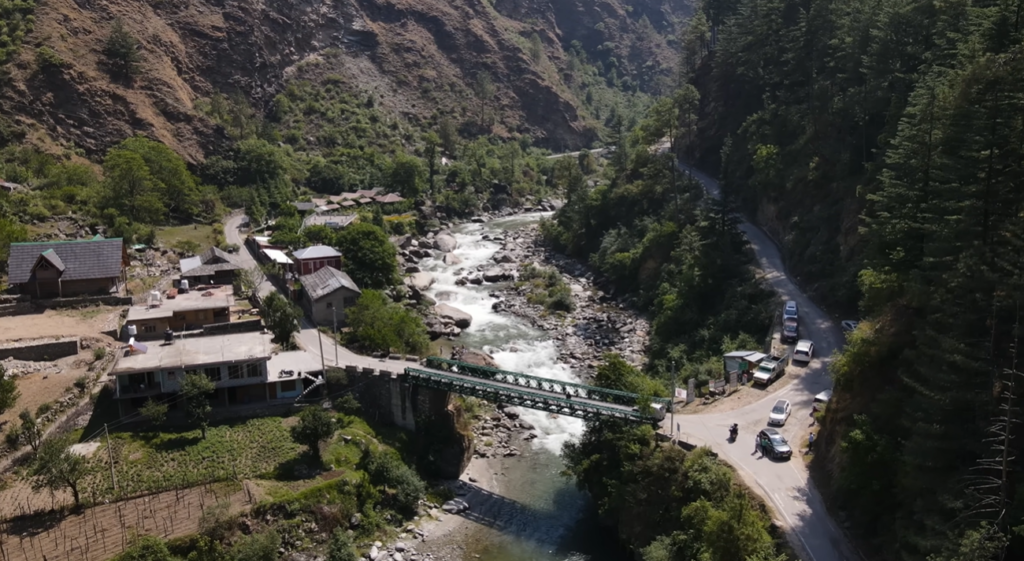
The “Hidden” 25km Trek: The Path to the Interior
Most travelers stop at the Sissu lake for a selfie and turn back. To find the “North,” you have to push into the nameless trails that connect the Lahaul interior to the high ridges overlooking the Chenab Valley.
| Feature | Details |
| Distance | Approximately 25 kilometers (Point-to-Point) |
| Peak Altitude | Touching 4,200 meters at the ridge crest |
| Terrain | Glacial moraine, high alpine meadows, and narrow goat-paths |
| Vibe | Raw, unmanicured, and devoid of cellular signal |
The route begins by ascending the steep ridges behind the Sissu waterfall, bypassing the popular viewpoints. Within 5km, the road-noise vanishes. By 12km, you are in a high-altitude “no man’s land.” This is the raw beauty tourists miss: the sight of a lone Himalayan Griffon circling a valley that hasn’t seen a permanent structure in centuries; the “watermelon snow” (pinkish algae) on the remaining drifts; and the tiny, resilient blue poppies blooming in the shadows of boulders.
Finding the “North” in the Silence
In the plains, “North” is a direction on a map. In these mountains, “North” becomes a state of being.
Around the 18km mark, as I sat on a ridge where the mist of Jammu met the dry wind of Lahaul, the silence became heavy. It wasn’t the absence of sound, but the presence of scale. When you are 25km away from the nearest “Main Mall Road,” the mental noise of the 40°C city—the deadlines, the notifications, the social performances—simply evaporates.
I found my “North” in that silence because there was nothing left to react to. There was only the rhythm of my own breath and the realization that these mountains don’t care if you are there or not. That indifference is incredibly freeing. You stop trying to “conquer” the trail and start simply existing within it.
The “North” isn’t a destination; it’s that moment of clarity when the external world goes quiet enough for your internal compass to finally stop spinning and point true.
The “Minimalist Rucksack” isn’t about how much you carry; it’s about how much you let your belongings carry you. When you’re 4,000 meters up in the Lahaul backcountry, every gram in your pack and every notification on your screen is a tax on your presence.
The philosophy is simple: High-tech gear, low-frequency usage. I carry the latest tools because they are efficient and lightweight, but I treat them like emergency flares—vital when needed, invisible when not.
The Tech vs. The Signal
I travel with the OnePlus Pad 4 (its massive 12,140mAh battery is a beast for long-haul isolation) and a few AI-integrated workflows. But when the signal drops near the Sissu-Jammu border, the tablet transforms from a communication hub into a silent digital stone.
- Offline Journaling: I don’t use AI to write my thoughts while on the trail; that would defeat the purpose of the “human” experience. Instead, I use the Stylo 2 to hand-write in a journaling app (like Obsidian or Day One) that supports full offline sync. There is something meditative about the scratch of a digital pen on glass while sitting by the Chandra River, knowing these words won’t touch the “cloud” until I’m back in civilization.
- Mapping as Art: For navigation, Gaia GPS with downloaded topographic layers is non-negotiable. I use the tablet’s large screen at night in the tent to study the contours of the next day’s 25km push. It makes the geography feel like a story you’re about to read, rather than just a blue dot on a tiny phone screen.
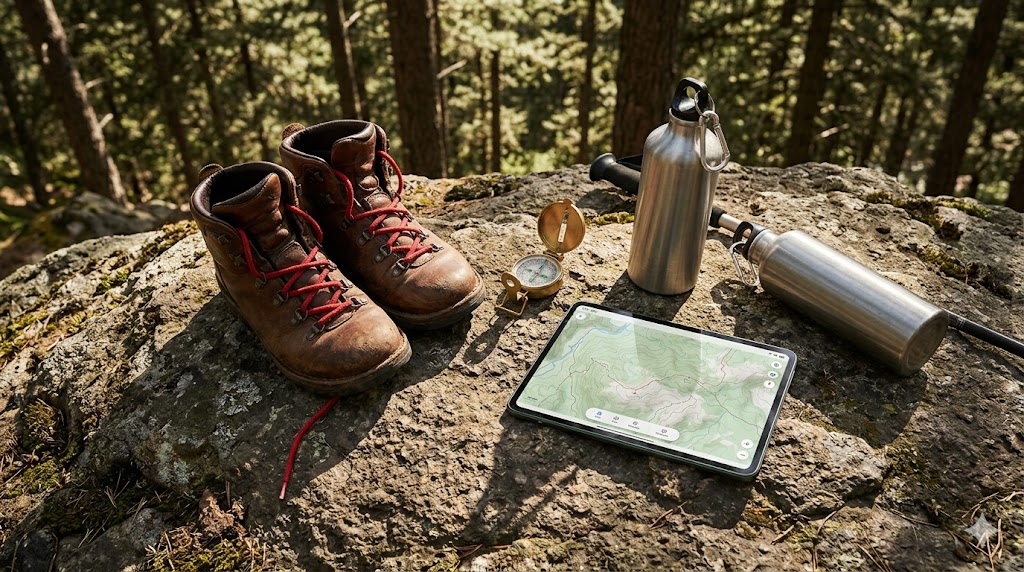
Discipline: Digital Minimalism
On the trail, I practice “Batching.” My devices stay in Deep Power Save and Airplane Mode for 22 hours a day. The remaining two hours—usually at camp—are for the “Digital Audit”: checking the route, logging a few lines of a journal, and perhaps a single photo. The discipline lies in not letting the camera lens become your primary eyeball. If you’re looking at the sunset through a 144Hz display, you’re not in the Himalayas; you’re in a theater.
3 Practical Tips for High-Altitude Tech
- The “Body-Heat” Battery Hack: At high altitudes, the cold is a battery vampire. Never keep your tech in the outer pockets of your rucksack. At night, your tablet and phone should be inside your sleeping bag, near your feet or chest. Your body heat keeps the lithium-ion chemistry stable; a tablet left in the tent vestibule at -5°C will lose 30% of its charge by dawn without even being turned on.
- The “Ziploc” Humidity Shield: Moving from the freezing morning air into a sun-warmed tent creates instant condensation. Keep your electronics in a large, airtight Ziploc bag. It acts as a pressure and moisture buffer, preventing the “internal fog” that can fry the circuits of a premium device like the OnePlus Pad.
- The “Analog-First” Rule: Before you check the GPS, look at the horizon. Use the tech only to confirm what your senses are telling you. If you can’t navigate the next 5km using a physical landmark (that “first snow-capped peak” we saw earlier), you’re leaning too hard on the silicon. Use the tech to enhance your safety, not to replace your intuition.
The result? You return from the Jammu mountains with a rucksack full of data, but a mind that is finally, mercifully, empty.
n my new “Lifestyle” philosophy, I’ve stopped looking at a 25km mountain climb as an escape. Instead, I see it as a Physical Audit—a brutal, high-altitude diagnostic of the soul.
When you are at 4,000 meters, your legs screaming and your lungs clawing for oxygen that isn’t there, you aren’t just trekking; you are stress-testing your own resilience. This is the “Renaissance Student” mindset: the belief that the grit required to crest a ridge in the Jammu mountains is the exact same currency used to survive a market downturn or master a complex art form.
The Parallel of Resilience: From Scree to Stocks
The discipline of the trail is a universal blueprint for long-term success. Whether you’re looking at finance, art, or adventure, the mechanics of endurance are identical.
- Long-Term Investing (The Kissht IPO & Beyond): Much like the current buzz around the Kissht IPO in May 2026, investing isn’t about the 100-meter dash; it’s about the 25km grind. The market has “false summits”—moments where you think you’ve reached the peak only to see another vertical climb ahead. The mental fortitude required to stay invested when the “air gets thin” (market volatility) is the same discipline you use to keep your boots moving when you’re exhausted. You don’t quit because the terrain is hard; you trust the trajectory.
- The Mastery of Skill (The Kathakali Method): Learning a discipline like Kathakali is a physical and mental marathon. The hours spent mastering the Navarasas (expressions) or the grueling leg positions are the “mountain miles” of the performing arts. Just as the trek teaches you to find “North” in the silence, classical arts teach you to find center in the chaos. Both require you to embrace the burn until it becomes a baseline.
Why Travel is the Ultimate Character-Building Exercise
For the Renaissance Student, travel is not a “holiday”—it’s a laboratory.
“A holiday seeks comfort; a trek seeks friction.”
We seek this friction because it builds a specific type of Human Capital that a classroom or an office cannot provide:
- Adaptive Intelligence: When the mist rolls in over a Jammu ridge and your GPS (even on the OnePlus Pad) becomes a secondary tool to your intuition, you are practicing high-stakes problem solving.
- Delayed Gratification: The “summit” is a singular moment of joy preceded by six hours of labor. This ratio is the secret sauce of the “Lifestyle” category—learning to love the 95% of the effort as much as the 5% of the result.
- The Ego Strip-Down: High-altitude environments are indifferent to your social status, your bank balance, or your tech stack. This humility is essential for anyone trying to learn a new skill. You have to be okay with being “the beginner” on the mountain before you can be the master in the boardroom.
The Audit Result
By the time you descend back toward the Chandra River, you’ve done more than just burn calories. You’ve audited your patience, your pain threshold, and your ability to stay calm when the “signal” of life goes dark.
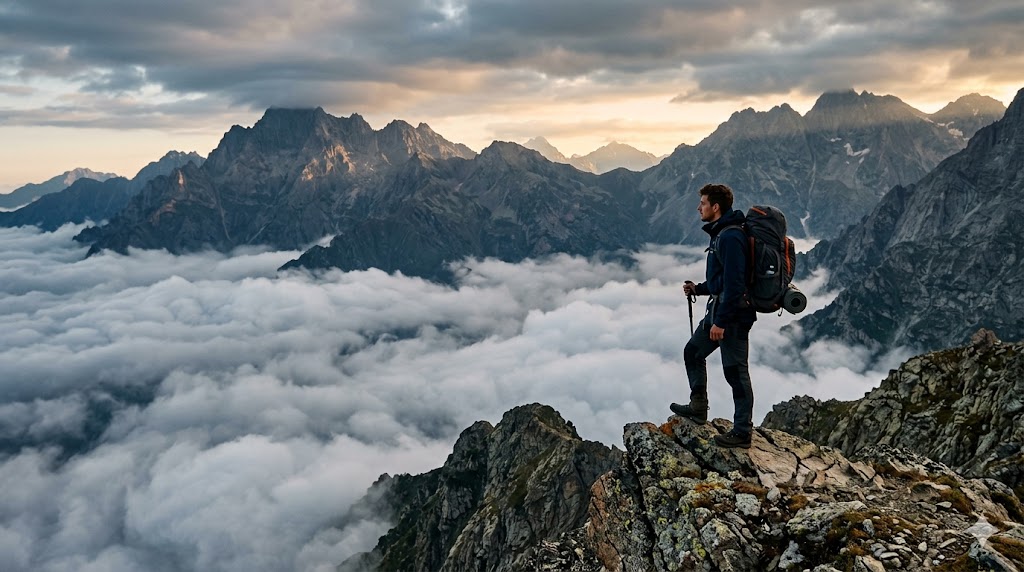
This is the core of the new Lifestyle: we don’t go to the mountains to find ourselves; we go to build ourselves, one grueling kilometer at a time, so that when we return to the 40°C heat of the plains, we are prepared for any climb—be it a financial IPO or a cultural masterpiece.
Is there a particular “climb” in your professional or creative life right now that feels like that 25km stretch?
The heat is rising, and the mountains are calling, but the “North” isn’t a coordinate on a map—it’s a commitment to yourself. Whether you have four days for a high-altitude dash to Lahaul or just four hours for a local trail, this weekend is your opportunity to conduct your own physical audit.
Stop waiting for the “perfect” season. The air in the high country is crisp, the glaciers are holding their ground, and the silence of the Jammu ridges is waiting to absorb your mental noise. It’s time to trade the static of the plains for the symphony of the trail.
⛰️ The Quick Weekend Escape Checklist
If you’re feeling the “40°C fever,” use this checklist to prep your escape:
- [ ] The Tech Buffer: Download your offline maps (Gaia or Google Maps) and sync your journaling app tonight. Put your OnePlus Pad or phone on a full charge cycle, but resolve to keep them in airplane mode once the climb begins.
- [ ] The Gear Prep: Dust off your rucksack. If you’re heading high, pack your layers (merino wool is your best friend) and double-check your hydration bladder for leaks.
- [ ] The Thermal Strategy: Pack a high-SPF sunscreen and a lightweight wide-brimmed hat. The May sun at 3,000m is thinner and sharper than the heavy heat of the city.
- [ ] The “Body-Heat” Kit: Grab a few dry-bags or Ziplocs for your electronics to protect them from the altitude-induced condensation we discussed.
- [ ] The Renaissance Goal: Identify one “burn” you want to embrace. Are you auditing your patience, your physical endurance, or your ability to sit in silence?
Don’t just survive the summer—transcend it. Find the friction that makes you feel alive and the silence that makes you feel clear.
Beyond the Peak: Finding My North.