

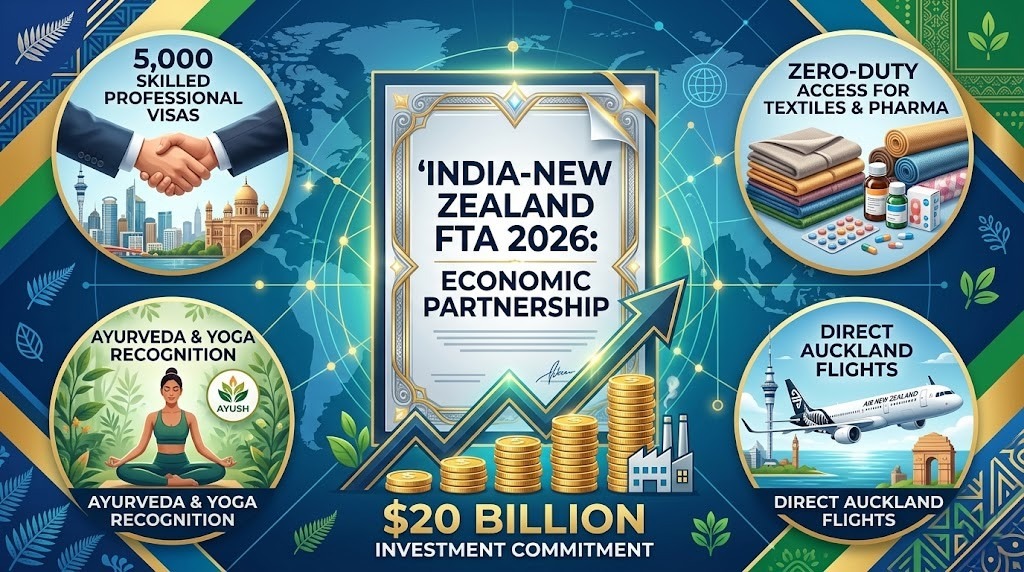
The Event: Today at Bharat Mandapam, Union Commerce Minister Piyush Goyal and New Zealand’s Minister for Trade and Investment Todd McClay are officially sealing the India-NZ FTA.
The Investment: New Zealand has committed to investing $20 Billion in India over the next 15 years. This is a massive “Finance” category win, similar to the EFTA deal.
Trade Goal: The target is to double bilateral trade to $5 Billion within the next 5 years.
The Oceania-India Trade Corridor: A Strategic Hub
The FTA establishes a new Oceania-India Trade Corridor, positioning New Zealand not merely as a final destination but as a high-efficiency logistics hub for the broader South Pacific. By securing 100% duty-free market access for Indian exports, the agreement allows Indian manufacturers to use New Zealand’s advanced maritime infrastructure as a “backdoor” into the Pacific Island Countries (PICs).
Products arriving from India—ranging from pharmaceuticals to engineering components—can be warehoused and redistributed from New Zealand ports to smaller Pacific nations like Fiji, Samoa, and Tonga. This regional integration leverages New Zealand’s existing trade networks and the Comprehensive and Progressive Agreement for Trans-Pacific Partnership (CPTPP) framework, effectively reducing the lead times and shipping costs that have historically hindered Indian trade with the isolated Pacific region.
Local Currency Settlement (LCS) & The De-Dollarization Pivot
A cornerstone of the “Financial Services Annex” in this FTA is the implementation of a Local Currency Settlement (LCS) framework. This allows Indian and New Zealand importers and exporters to invoice and pay in Indian Rupees (INR) and New Zealand Dollars (NZD), bypassing the traditional reliance on the US Dollar (USD) as an intermediary currency.
Impact on National and Personal Finance:
- Strengthening the Rupee: By facilitating direct INR-NZD trades, the agreement increases the international utility of the Rupee, reducing India’s vulnerability to USD volatility and strengthening its global standing as a viable trade currency.
- Eliminating “Exchange Fee Shocks”: For Indian students and expats in New Zealand, this is a critical financial safeguard. Standard international wire transfers often involve double conversion (INR to USD, then USD to NZD), with banks taking a 3–5% cut at each stage.
- Direct Remittances: The LCS provisions enable direct digital payment integration—linking systems like India’s UPI with New Zealand’s banking networks—ensuring that tuition fees and living expenses can be paid without the “hidden tax” of multiple foreign exchange conversions.
The 5,000 Special Visa Quota: Cultural & Skill Specifics
The 5,000 Special Visa Quota represents a strategic pivot in New Zealand’s immigration policy, moving beyond generic labor shortages to recognize specific “iconic occupations” central to Indian heritage. While IT and engineering remain core components of the quota, the FTA carves out protected slots for professionals whose skills are traditionally difficult to quantify under standard Western vocational frameworks.
Unique Cultural Occupational Categories
For the first time in a major trade agreement, New Zealand has formally recognized and provided dedicated entry for:
- Traditional Indian Medicine (AYUSH) Practitioners: Including experts in Ayurveda, Unani, Siddha, and Homeopathy. This aligns with a dedicated “Annex on Health and Traditional Medicine” within the FTA.
- Yoga Instructors: Certified practitioners who can now work in New Zealand’s growing wellness and fitness sectors.
- Classical Indian Dance & Music Teachers: Specialized educators in forms such as Bharatanatyam, Kathak, and Hindustani/Carnatic music, supporting the cultural needs of the 300,000-strong Indian diaspora in New Zealand.
- Indian Chefs: Acknowledging the high demand for authentic culinary expertise that meets specific cultural and technical standards.
“Much like mastering the [AI-Human Hybrid skills] we discussed yesterday, securing a spot in the 5,000-visa quota requires staying ahead of tech trends.”

Bypassing Labor Market Testing (LMT)
Crucially, these 5,000 slots operate under a Temporary Employment Entry (TEE) framework that effectively bypasses the standard Labor Market Testing rules. Ordinarily, a New Zealand employer must prove they have unsuccessfully attempted to recruit a local citizen or permanent resident before hiring an offshore candidate.
Under this FTA, once an Indian professional falls within this 5,000-person quota for these specific sectors, the employer is exempt from the LMT requirement. This removal of bureaucratic friction ensures that Indian practitioners can be onboarded rapidly, treating their cultural expertise as a pre-verified “specialized skill” that does not compete with the existing domestic labor pool.
The Aura Visa & The Startup Pipeline
The FTA further integrates with New Zealand’s Aura Visa—a specialized residency pathway designed for high-impact entrepreneurs and startup founders. By establishing structured cooperation for MSMEs and startups, the deal simplifies the “proof of concept” phase for Indian founders. The FTA’s provisions on regulatory cooperation and digital trade frameworks allow Indian SaaS, fintech, and healthtech founders to demonstrate market viability in New Zealand more easily. This alignment effectively turns the Aura Visa from a high-barrier prestige visa into a functional bridge, providing Indian entrepreneurs with a streamlined administrative route to establish “New Zealand-born” global ventures while retaining their Indian innovation roots.
The Direct Flight Dividend
A transformative logistical component of the FTA is the formal mandate to re-establish and maintain direct, non-stop air connectivity between India’s major hubs (Delhi and Mumbai) and Auckland. Historically, this route has been inconsistent, forcing travelers into grueling 20+ hour journeys involving multi-stop layovers in Singapore, Sydney, or Kuala Lumpur.
Under the new aviation provisions:
- Time Savings: Non-stop services will slash travel time to a mere 14 hours, effectively removing a full day of transit for professionals and students.
- Bilateral Code-Sharing: The agreement specifically authorizes expanded Bilateral Code-Sharing agreements between Air India and Air New Zealand.
- Seamless Domestic Links: For an Indian expat, this is a game-changer; it allows for a single-ticket booking that seamlessly connects a domestic flight from a Tier-2 Indian city (like Pune or Hyderabad) directly through to Auckland.
This streamlined “one-hop” connectivity significantly elevates the standard of living for the diaspora, making emergency travel, family visits, and business commuting radically more accessible.
| Feature | Impact for Indian Professionals |
| 5,000 Visa Quota | Bypasses Labor Market Testing for unique cultural roles. |
| Pharma MRA | Reduces personal healthcare costs by up to 60%. |
| LCS Framework | Direct INR-NZD settlement; zero USD conversion fees. |
| Direct Flights | Travel time reduced from 20+ hours to 14 hours. |

“With direct flights becoming a reality, the choice between domestic luxury like [Andaman vs. Lakshadweep] and international exploration becomes much easier for the modern Indian traveler.”
The Pharma Pivot: Indian Generics vs. Oceania’s Big Pharma
One of the most consequential yet understated pillars of the FTA is the formalization of Mutual Recognition Agreements (MRAs) regarding Good Manufacturing Practices (GMP). Historically, Indian pharmaceutical exports faced significant non-tariff barriers in the Oceania region, often requiring redundant clinical audits and secondary testing protocols already cleared by international regulators. Under this new framework, New Zealand’s regulatory bodies officially recognize the GMP certifications issued by Indian authorities for accredited facilities.
Streamlined Market Entry for Industry Leaders
This regulatory alignment allows Indian pharmaceutical giants—such as Sun Pharma, Dr. Reddy’s Laboratories, and Cipla—to bypass years of bureaucratic “re-validation” that typically delays the entry of generic drugs into the New Zealand market. By accepting Indian standards as equivalent to their own, New Zealand effectively integrates India’s high-volume, low-cost manufacturing capabilities directly into its national healthcare supply chain.

“The recognition of Ayurveda in this deal is a win for holistic health. Managing the stress of a global move starts with [optimizing your sleep and recovery cycle].”
Financial Implications for Indian Professionals
For an Indian expat or professional relocating to New Zealand, this pivot translates into a direct and substantial reduction in the cost of living. The integration of Indian generics disrupts the local market, which has historically been dominated by high-margin Western brands.
- Cost Reduction: Access to affordable Indian-made medications can reduce personal healthcare costs in cities like Auckland by up to 60% compared to Western-branded alternatives.
- Chronic Care Management: For professionals managing long-term conditions (such as hypertension, diabetes, or cholesterol), the availability of trusted, bio-equivalent generics from familiar Indian firms ensures continuity of care without the “price shock” often associated with Western healthcare systems.
- Healthcare Security: This agreement ensures that the Indian professional community in New Zealand maintains access to the same high-quality, cost-effective pharmaceutical ecosystem they relied on domestically, mitigating one of the most significant hidden expenses of international relocation.
“When comparing the cost of living, New Zealand stands as a premium option alongside our recently [Plan B countries like Paraguay and Ecuador].”
“I’ve always believed that the best opportunities come to those who look where the crowd isn’t. While everyone is talking about the US or UK, New Zealand just opened a massive door for 5,000 of us. After my 25km trek in Jammu, I realized that the hardest climbs lead to the best views. This FTA is that ‘hard climb’ for your career—are you ready to take the first step?”





[…] ₹25,000 on flight tickets is the ultimate [Finance hack for 2026], allowing you to invest more in your global […]
[…] “The color accuracy is also a vital asset for those tracking complex economic data, such as the visual maps provided in our [comprehensive breakdown of the India-New Zealand FTA].” […]